(516) 271-2958










What Are Oral Surgery Medical Billing Services?
Oral surgery medical billing services manage the financial workflow behind surgical care, including medical and dental insurance billing, CDT/CPT/
Complex surgical claims. Better payer control. Faster collections.
MedsDental manages dual medical-dental coverage, surgical coding, anesthesia, prior authorization, hospital coordination, and high-value A/R. Our expert + AI workflows keep complex OMS claims moving from pre-op approval through final payment.
Oral surgery medical billing services manage the financial workflow behind surgical care, including medical and dental insurance billing, CDT/CPT/
Oral surgeons outsource billing to gain dedicated expertise in payer routing, surgical documentation, anesthesia, global surgery rules, and high-value A/R without expanding their in-house staff. Specialized billing reduces errors between authorization, surgery, claim filing, and payer follow-up.
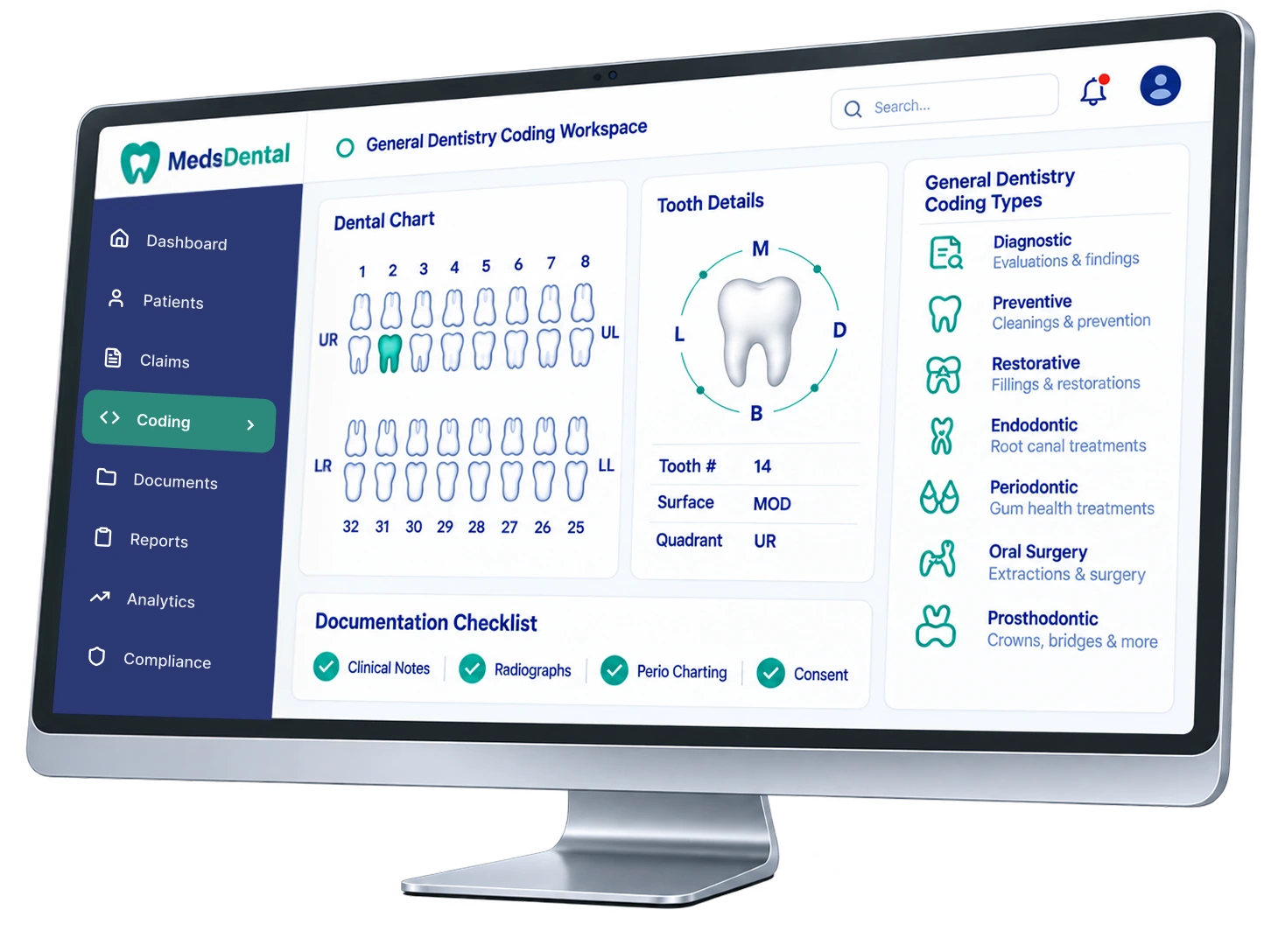
Our expert general dentistry medical billing services and interactive billing solutions are designed to improve accuracy, reduce denials, and strengthen your dental practice revenue.
We manage oral surgery claims processing from case review through payer adjudication. Each claim is checked against the completed procedure, diagnosis, authorization, operative documentation, payer routing, and filing requirements before submission.
Primary payer, secondary payer, and coordination-of-benefits order verified.
Operative notes, imaging, pathology, and supporting records matched.
Rejected, pending, denied, and unpaid surgical claims actively tracked.
We determine whether each OMS case belongs under dental insurance, medical insurance, or coordinated coverage. Our experts review benefit structure, diagnosis, procedure, payer policy, and plan exclusions before the claim enters the wrong reimbursement path.
Medical and dental coverage obligations identified before treatment billing.
Primary and secondary payer sequence validated for dual-covered cases.
Medical and dental responses reconciled to prevent duplicate billing.
We manage prior authorization for oral surgery around the actual surgical plan. Procedure codes, diagnosis, medical necessity, imaging, treatment dates, and authorization limitations are tracked so approvals remain usable when surgery is performed.
Payer-specific preauthorization requirements confirmed before scheduling.
Clinical notes, imaging, diagnosis, and supporting records organized.
Approved procedures, dates, units, and final treatment compared.
Our oral surgery coding services connect the clinical procedure to the correct CDT, CPT, HCPCS, and ICD-10-CM pathway. Coding is checked against operative findings, anatomy, diagnosis, surgical complexity, payer rules, and supporting documentation.
Dental and medical code pathways aligned to documented surgery.
ICD-10-CM diagnoses checked against reported surgical procedures.
Applicable modifiers, surgical periods, and billing relationships assessed.
Anesthesia billing for OMS requires more than adding a sedation code. We review anesthesia type, provider role, documented time, procedure relationship, payer requirements, and operative records before submitting anesthesia-related charges.
Time records, sedation details, provider information, and notes checked.
Applicable anesthesia procedure codes and payer modifiers verified.
Reduced, denied, or unpaid anesthesia charges investigated and worked.
Our oral surgery revenue cycle management connects high-value surgical claims with payment posting, denial control, underpayment recovery, and dental accounts receivable follow-up. Every unresolved balance receives a defined next action based on payer status and age.
High-value and aging surgical balances worked by financial risk.
ERA/EOB payments, adjustments, and contractual amounts accurately posted.
Paid claims compared with expected reimbursement and fee schedules.
We manage oral surgeon credentialing services across commercial payers and eligible Medicare enrollment workflows. Provider demographics, NPI records, licenses, CAQH data, payer applications, and revalidation dates are kept aligned.
Applications and enrollment status tracked through activation.
Eligible provider enrollment and PECOS-related workflows supported.
Expirables, revalidations, and demographic changes monitored.
High-value OMS claims can lose substantial revenue through partial payments, coding reductions, authorization mismatches, or payer adjustments. We identify the financial reason behind each variance before deciding the next recovery action.
Authorization, coding, documentation, and payer reasons classified.
Paid amounts compared against expected contractual reimbursement.
Recoverable balances followed through payer reconsideration workflows.
Reduce preventable rework, protect approved procedures, and keep complex OMS revenue moving after surgery.
Oral surgery coding starts with the clinical event, not a code conversion chart. Our coders map the procedure, diagnosis, site, anesthesia, and surgical complexity to the appropriate CDT, CPT, HCPCS, and ICD-10-CM pathway. We also validate oral surgery CDT codes against documentation and payer requirements before claim release.
CDT and medical codes are matched to the documented procedure, diagnosis, and applicable benefit.
Impaction, imaging, diagnosis, surgical approach, and medical coverage criteria are checked before filing.
Clinical findings, radiographs, operative details, symptoms, and supporting records are organized when required.
Procedure, diagnosis, specimen-related documentation, and professional or facility components are separated correctly.
All coding checks passed and
claim is ready for submission.
Clinical evidence supports the reported surgical service and diagnosis.
Claims are structured around defensible documentation and payer requirements.
Medical and dental pathways are checked before submission.
Better claim preparation reduces avoidable surgical rework.
Billing controls built around the financial pressure points unique to oral and maxillofacial surgery.
Oral surgery revenue leakage often begins before the claim reaches the payer. For example, an authorization may not match the final surgery. A diagnosis may not support the intended medical pathway. An anesthesia record may be incomplete. Professional and facility claims may also move through different billing channels. MedsDental builds controls around those handoffs.
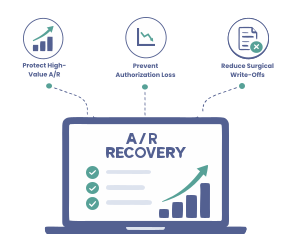
In our dental billing system, each case moves through benefit verification, authorization tracking, coding and documentation validation, payer routing, payment reconciliation, and A/R escalation. Here, high-value balances receive a defined next action instead of remaining in a general work queue.
This matters because orthognathic surgery, facial trauma, pathology, anesthesia, and reconstructive cases can involve several providers, payers, claim forms, and reimbursement rules.
Flags missing data, aging risk, payer exceptions, and claim anomalies for human validation.
Experienced teams supporting complex dental and medical reimbursement workflows.
CDT, CPT, HCPCS, and ICD-10-CM workflows aligned to documented care.
Disciplined follow-up keeps aging balances under active management.
Specialists supporting coding, documentation, payer follow-up, and high claim volumes.
Approval status, procedures, dates, units, and payer conditions tracked before surgery.
Root-cause trends and reimbursement variances are identified for recovery.
Surgical A/R is prioritized by balance, age, payer status, and required action.
Surgical
Extractions
Dental
Implants
Biopsy
Pathology
Oral
Pathology
Orthognathic
Surgery Billing
TMJ
Surgery
Fracture
Repair Billing
Anesthesia
Billing
Secure Oral and Maxillofacial Surgery Billing Services built around medical-dental coding, payer requirements, surgical documentation, enrollment, and compliant revenue cycle workflows.
Secure handling of patient, surgical, insurance, and payment information.
Coding expertise across CPT, ICD-10-CM, HCPCS, and medical claim workflows.
Current dental coding knowledge for extractions, anesthesia, grafting, and surgical care.
GAP Exceptions & No Surprises Act Compliance for OMS. We track OON claims & balance-billing cases.
Professional CMS-1500/837P billing coordinated with facility UB-04/837I workflows when applicable.
Our oral surgeon credentialing services support PECOS enrollment and Medicare billing setup for eligible covered services.
Global-day rules, postoperative services, staged procedures, and modifiers are checked before billing.
Provider roles, operative participation, payer rules, and applicable modifiers are validated before claim submission.
Billing workflows are adapted to surgical volume, hospital relationships, payer mix, anesthesia delivery, and the complexity of each oral surgery practice.
Solo Oral
Surgeons
OMS Group
Practices
Multi-Location
OMS Groups
Hospital-Based Oral
Surgeons
ASC-Affiliated
Practices
Dental Groups With
OMS Departments
Facial Trauma Call
Providers
OMS Practices
Providing Anesthesia

“The surgeries were clinically justified. The revenue problem started when medical necessity, authorization, and claim routing did not line up. Once those pieces were controlled before submission, the same high-value claims stopped returning to A/R.”
Dr. Michael Reynolds Make, DDS, MD
Oral & Maxillofacial Surgeon
Multi-Location OMS Practice
A multi-location oral surgery practice performing high volumes of impacted third molar extractions faced frequent medical claim denials, downgrades, and dental payer rerouting. Inconsistent diagnosis coding, medical-necessity documentation gaps, authorization mismatches, and unclear payer sequencing left high-value surgical balances unresolved and forced staff to rework claims repeatedly.
MedsDental built an OMS-specific pre-billing validation workflow for impacted extraction claims.
Before submission, each case was checked against the impaction diagnosis, operative plan, radiographs, symptoms, pathology or infection findings, prior authorization, payer coverage criteria, and final surgical documentation.
Our team also validated CDT-to-CPT cross-coding, ICD-10-CM diagnosis support, medical/dental payer order, and authorization-to-procedure matching before releasing the claim.
High-value denials were separated from routine A/R and assigned payer-specific recovery actions.
More surgical claims reached adjudication with the documentation and coding needed for reimbursement. Medical-versus-dental routing errors and authorization-related denials declined, while fewer claims required repeated rework. Better control over aging surgical balances also reduced staff time spent rebuilding denied claims.
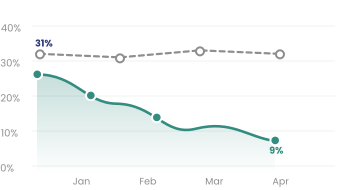
| Month | Before | After |
|---|---|---|
| Jan | 31% | 26% |
| Feb | 30% | 20% |
| Mar | 32% | 14% |
| Apr | 31% | 9% |
Connect your dental PMS, medical EHR, clearinghouses, imaging systems, e-attachment tools, hospital portals, and billing workflows through one coordinated revenue cycle. We ensure HIPAA-Compliant OMS billing workflows & PMS/EHR Integration.












OMS RCM Hub
One workflow. Total claim visibility.
Say goodbye to complexity. We address the full lifecycle of dental RCM. From verifying eligibility to filing accurate claims and beyond, our powerful platform, intelligent data
Dr. Nathan Brooks, DDS, MD
Pacific Coast Oral Surgery Center
Impacted extraction claims were delayed because approvals did not match final procedures. MedsDental added a pre-op authorization check for codes, diagnosis, dates, and payer conditions. Mismatches were corrected before treatment, reducing authorization-related rework.

Dr. Sophia Martinez, DDS, MD
Summit Oral & Maxillofacial Surgery
Facial trauma claims were denied because diagnosis coding and operative documentation did not support billed procedures. MedsDental reviewed ICD-10-CM, CPT codes, operative notes, and payer rules before submission, improving claim accuracy and reducing avoidable denials.
Dr. Daniel Carter, DMD, MD
NorthBridge Oral Surgery Group
Our Anesthesia claims were going unpaid because of missing time details and documentation gaps. MedsDental checked anesthesia records, provider information, codes, modifiers, and payer requirements before billing, improving documentation quality and payment accuracy.
MedsDental connects pre-op verification, coding, medical and dental insurance billing, claim filing, payment posting, denial management, and A/R recovery so your team can see what is approved, billed, paid, or still at risk.
Primary and secondary order, coverage pathway, and claim format are validated before release.
Authorizations, operative notes, imaging, pathology, and anesthesia documentation are prepared for review-sensitive claims.
Payments, adjustments, denials, and contractual variances are reconciled against expected reimbursement.
Clear answers to the coding, outsourced insurance verification, authorization, anesthesia, and reimbursement issues that make OMS billing different from routine dental claims.
Some oral surgery services may qualify for medical coverage when the diagnosis, procedure, and payer policy establish medical necessity. Trauma, pathology, corrective jaw surgery, and certain medically related procedures may qualify. Coverage must always be verified case by case. Medicare has narrower statutory dental coverage rules.
Yes, when the medical plan covers the condition and the documentation supports the medical claim. Billing typically requires the correct CPT or HCPCS procedure pathway, ICD-10-CM diagnosis, site of service, provider information, and payer-specific supporting records. There is no universal CDT-to-CPT conversion.
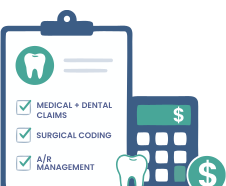
Services include eligibility verification, prior authorization, medical-dental cross-coding, claim preparation, anesthesia billing, CMS-1500 claims, payment posting, denial management, underpayment recovery, dental accounts receivable, reporting, credentialing, and oral surgery revenue cycle management.
Potential medical pathways can include facial trauma, jaw fractures, oral pathology, reconstructive procedures, orthognathic surgery, certain TMJ procedures, and other services tied to a covered medical diagnosis. The correct payer depends on plan language, diagnosis, clinical circumstances, and coordination-of-benefits rules.
Anesthesia reimbursement can depend on the service, provider role, payer, setting, documented time, procedure, medical necessity, and required modifiers. Missing or inconsistent anesthesia records can materially affect payment. Medicare anesthesia payment also uses defined anesthesia coding, base-unit, conversion-factor, and modifier rules.
Payment depends on the medical diagnosis, symptoms, impaction, pathology or complication, payer contract, documentation, and medical-plan exclusions. Routine extraction is frequently treated as dental. Medicare specifically lists extraction of an impacted tooth among services excluded under its general dental exclusion.
The surgeon’s professional service is generally billed separately from hospital facility charges. Billing may also involve imaging, anesthesia, fracture repair, assistants, follow-up care, and global-surgery rules. Accurate diagnosis, operative documentation, payer information, and coordination with the hospital are essential.
A global surgical package groups specified services normally related to a surgery into one payment period. Routine postoperative care may therefore be included rather than separately payable. Separate services require correct documentation and applicable modifier logic when payer rules permit additional billing.
More collections. Less stress. That’s the MedsDental promise.








 CLAIM READY





 HIPAA Compliant
 Weekly A/R Reviews
 OMS-Focused Reporting























 Medical necessity match