


Dental Billing Audit Services
Our Audit Expertise
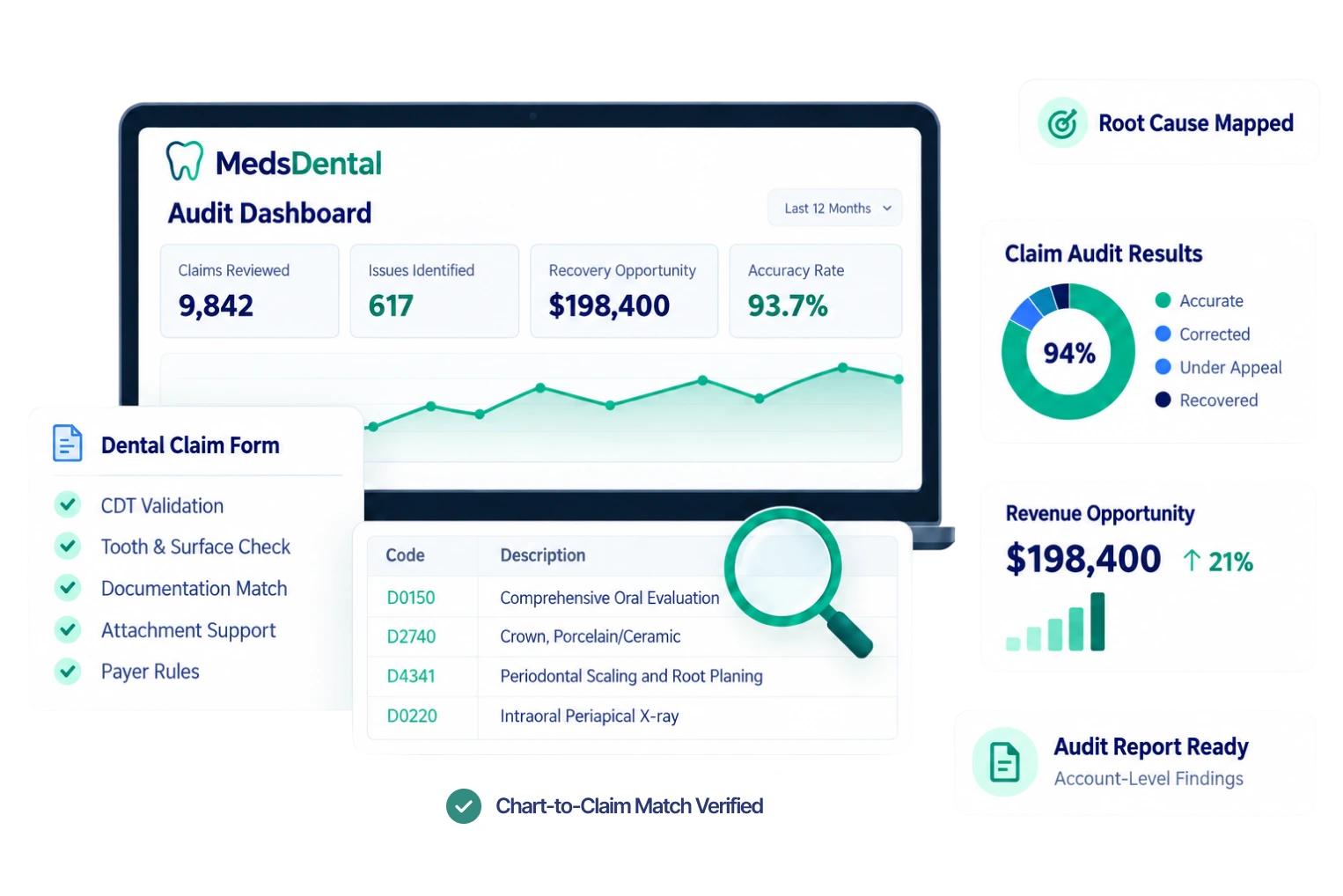
 Dental Billing & Coding Accuracy Audit
- Chart-to-Claim Documentation Matching
- Dental Claims Audit & Denial Analysis
- PPO Write-Off & EOB Reconciliation
- Insurance A/R & Aging Analysis
- Patient Ledger & Credit Balance Audit
 Coding Accuracy
 Payment Integrity
 Compliance Review
 Denial Analysis

Our Core Strengths

Claims

Specialties

Served

Expertise

Billing
Claim Rate
What Changes When You Audit Your Dental Billing Every Six Months
A side-by-side look at what can remain hidden without periodic dental audits and what becomes actionable once claims, payments, adjustments, and ledgers are tested together.

When Dental Billing Goes Unaudited
Risk compounds quietly across claims, adjustments, ledgers, and follow-up.
-

CDT and Claim-Detail Errors
Incorrect CDT codes, tooth data, or missing attachments can cause avoidable claim rework.
-

PPO Write-Offs Without Validation
Adjustments from estimated fee schedules can bury balances never checked against the EOB.
-

A/R That Ages Without Ownership
Missing COB, attachments, or follow-up can turn fixable claims into late A/R.
-

Patient Ledgers Stop Reconciling
Misapplied payments, credits, refunds, or transfers can misstate patient responsibility.
-

Control Gaps Become Routine
Repeated overrides, voids, refunds, and adjustments can slip by without exception testing.


What a Timely Dental Audit Changes
A focused audit turns scattered account exceptions into actions your team can verify and correct.
-

More Accurate Claim Data
Chart-to-claim checks catch coding and support gaps before they repeat.
-

Validated Payer Adjustments
EOBs, fee schedules, and PPO rules validate each contractual adjustment.
-

Actionable Insurance A/R
Claims are prioritized by denial cause, deadline, recoverability, and next action.
-

Accurate Patient Balances
Payments, COB, credits, and responsibility are reconciled to each ledger.
-

Better Financial Controls
Exception testing creates ownership rules for unusual adjustments and transactions.

Turn Audit Findings Into Financial Action
 Accurate Claims
 Controlled Write-Off
 Recoverable A/R

Our Dental Billing Audit Services
From CDT coding to patient ledgers, we audit every stage of your billing, then rank findings by financial impact and show your team exactly how to fix them.
-
Dental Billing & Coding Audit Services
We trace CDT selection, tooth and surface data, claim fields, attachments, and payer responses to find dental coding errors that distort reimbursement or trigger repeat rework.
-
Dental Chart Audit & Clinical Documentation Review
We match billed treatment to clinical notes, radiographs, periodontal charting, narratives, and procedure support so documentation and the submitted claim tell the same story.
-
Dental Claims Audit
We test submitted and paid claims for coding, patient data, attachments, frequency limits, downgrades, and bundling, as well as adjudication patterns that create preventable revenue loss.
-
Dental Insurance AR & Aging Audit
We segment insurance balances by payer, age, denial cause, last action, and recoverability, then isolate claims needing appeal, correction, escalation, or patient transfer.
-
PPO Write-Off & Contract Audit
We compare posted contractual adjustments with EOBs, allowed amounts, and payer terms to catch premature, duplicated, or unsupported PPO write-offs and route them for underpayment recovery.
-
Payment Posting & EOB Audit
Our insurance payment verification reconciles checks, EFTs, ERAs, EOBs, adjustments, and patient responsibility against the ledger to find misapplied payments, missing postings, and unexplained variances.
-
Verification & Eligibility Process Audit
We test effective dates, waiting periods, frequencies, maximums, and coordination of benefits on dual-coverage accounts before incorrect benefit assumptions reach claims or patient estimates.
-
Financial Control & FWA Audit
We test unusual adjustments, refunds, voids, deleted transactions, and repeated overrides for patterns that may point to embezzlement risk or fraud, waste, and abuse exposure.
-
Patient Ledger & Credit Balance Audit
We rebuild selected ledgers, from charges through insurance and patient payments, to resolve credits, unapplied funds, incorrect transfers, refunds, and inaccurate patient balances.
-
Audit Reporting & Corrective Action
We rank findings by financial impact, risk, and recurrence, then define ownership, evidence, correction steps, and a documentation standard your team can follow for every future audit cycle.



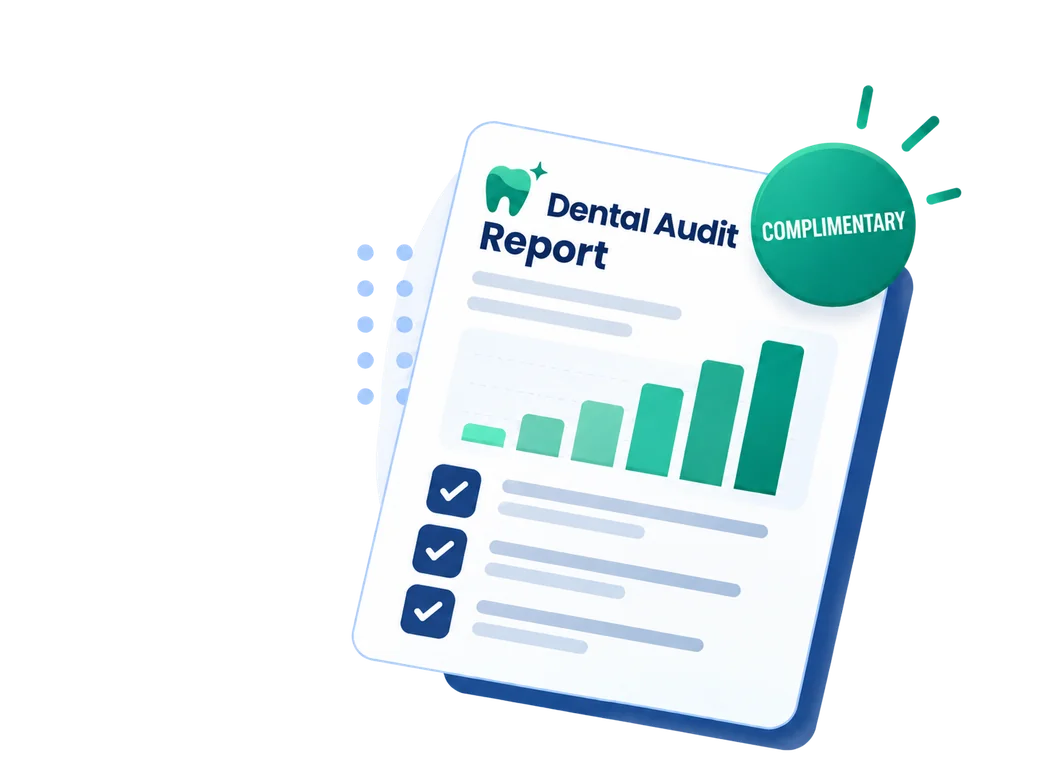
Get a Complimentary Dental Billing Audit
Included at no extra cost with our complete MedsDental RCM services.
 Find Revenue Gaps
 Test Write-Offs
 Reconcile A/R

Turn Exceptions Into Action
Why Dental Practices Choose MedsDental for Audit-Led Growth
Dental revenue rarely disappears in one obvious place. It is usually split across small errors such as a surface entered incorrectly, an attachment omitted, a payment adjustment posted to the wrong bucket, a PPO write-off never reconciled against the EOB, or a secondary plan never billed. MedsDental applies its Dental RCM Services experience to every transaction, from chart and claim to payment and patient balance, as part of a full revenue cycle assessment.
Our dental auditing service does more than flag exceptions. Each finding is tied to the account, payer response, workflow step, and corrective action behind it.
That gives your team a usable recovery list and clearer financial controls, while our dental billing management services turn each finding into a fix in the next cycle.
-
 1000+Dental Practices
-
 20+PMS Platforms
-
 <3%Denial Benchmark


8 Reasons to Choose Our Dental Practice Audit Services
 011000+ Dental Practices Served
 02700+ Dental Billing Specialists
 03Dental PMS Platforms’ Experts
 0411+ Years of Dental RCM
 05<3% Denial Benchmark
 0622 Days in A/R
 0799% Net Collection
 08Account-Level Corrective Reporting
Audit the transaction. Find the cause. Fix the process.





Dental Coding Audit Services
MedsDental audits CDT selection, claim data, and documentation as a single chain, so every coding issue can be traced to its financial impact.
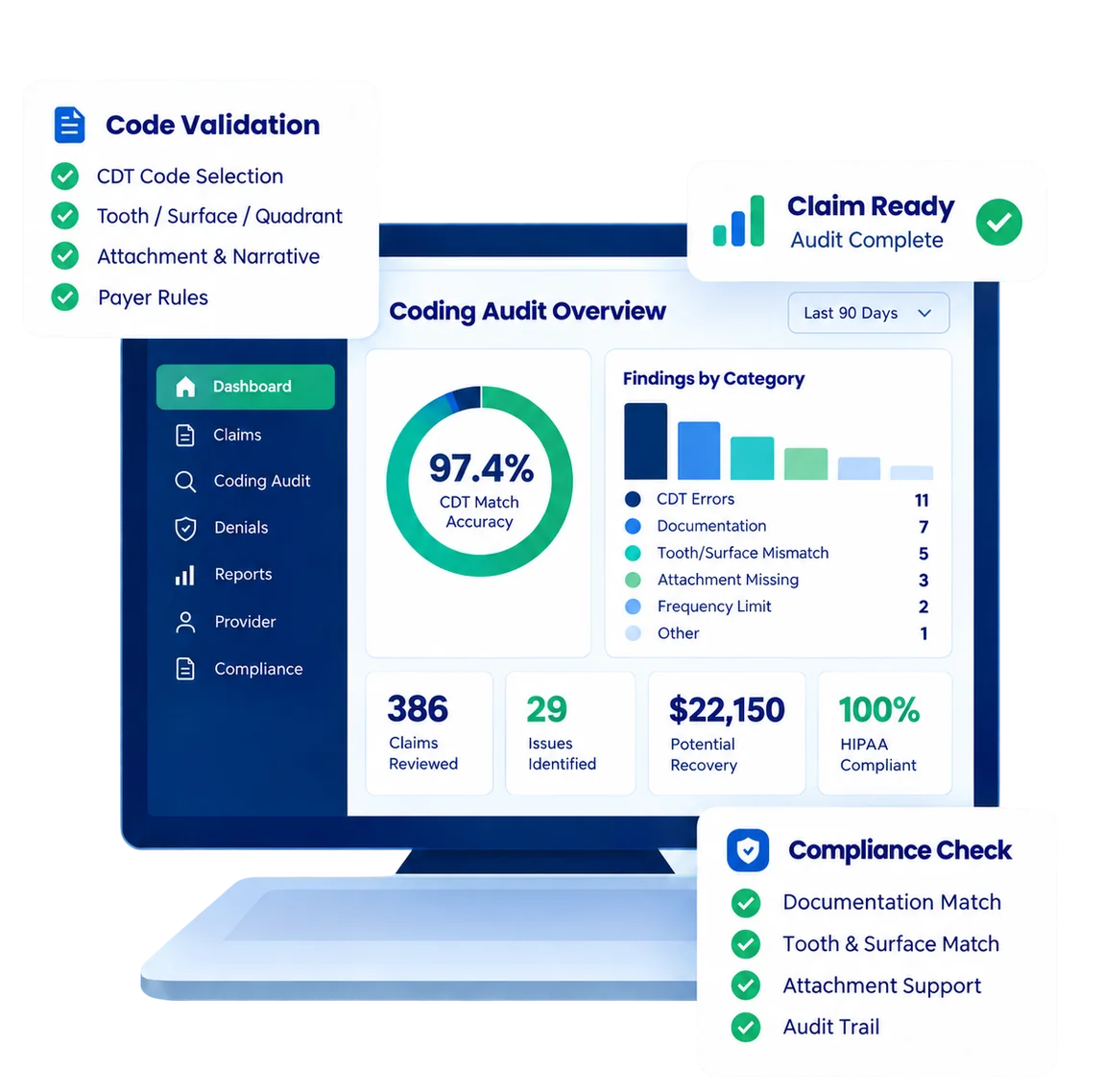
Technical Dental Coding Audit Framework
-
01

CDT Procedure Code Validation
Confirms code selection matches documented treatment and the applicable date-of-service code set.
-
02

Tooth, Surface & Quadrant Check
Verifies tooth, surface, and quadrant data across chart and claim, like D4341/D4342 accuracy.
-
03

Documentation-to-Code Reconciliation
Matches clinical notes, charting, radiographs, and procedure support to billed services.
-
04

Attachment & Narrative Sufficiency
Checks supporting records for procedures that commonly require payer-specific evidence.
-
05

Payer Rule & Benefit Logic Audit
Separates coding accuracy from plan limits, exclusions, frequencies, and reimbursement rules.
-
06

Revenue & Compliance Impact Mapping
Prioritizes underbilling, overbilling, denials, write-offs, and documentation risks.
Dental Insurance A/R Audit That Shows Why Balances Age
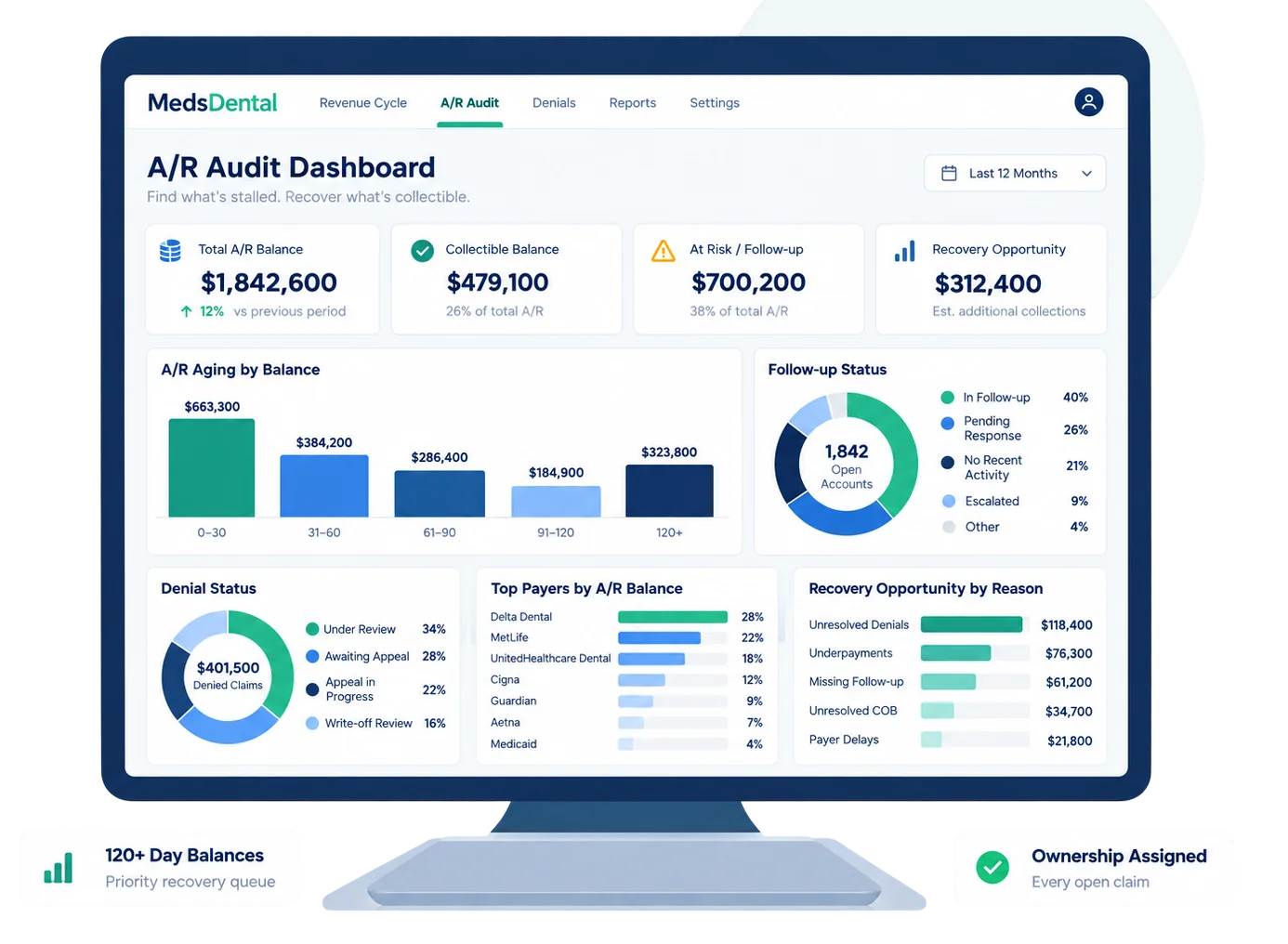
Dental A/R may look healthy overall, while collectible insurance dollars remain buried in 60-, 90-, and 120+ day balances. We audit aging by payer, claim status, denial reason, last action, and balance ownership to separate true payer delay from missed follow-up, missing attachments, unresolved COB, downgraded benefits, or posting errors.
Our dental insurance A/R audit also tests open balances against EOB history, timely filing limits, resubmission activity, and patient responsibility. Aging analysis then groups accounts by recoverability and next action rather than by age alone, producing a prioritized worklist that shows what can still be collected, what needs an appeal or correction, what should move to the patient, and what requires a ledger adjustment.
- 30 DAYS
- 60 DAYS
- 90 DAYS
- 120+ DAYS
Know why it aged. Know what happens next.


Audit Services Built for the Complexity of Every Dental Specialty
Specialty billing errors rarely come from one bad code. They appear when clinical detail, CDT logic, payer rules, and reimbursement requirements stop matching. Our audits follow those connections from general dentistry through oral surgery billing services.
That means reviewing each procedure in its real billing context. Orthodontic cases require scrutiny around lifetime maximums and continuation claims. Periodontal billing depends on charting, frequencies, and benefit limits. Endodontic claims demand tooth-level documentation, radiographs, and proof that treatment was completed.
MedsDental applies specialty-specific audit logic across general dentistry, pediatrics, orthodontics, periodontics, endodontics, prosthodontics, and oral surgery. We trace clinical support, CDT selection, attachments, adjudication, and ledger activity together. For dental medical billing services, we separately examine diagnosis support, claim routing, and payer requirements to keep medical and dental workflows accurately separated.
- CPT
- Tooth/Surface
- Attachments
- Frequency Limits
- Payer Edits
Different procedures. Different risks. Specific audit logic.
20+ DENTAL SPECIALTIES AUDITED


Specialty-aware review of CDT selection, frequency limits, attachments, and payer adjudication.
70+
SPECIALTY INSIGHT · REAL IMPACT
Who Our Dental Billing Auditing Service Supports

-
Solo Practices & Small Practices
-
Independent Practices
-
Family Dental Practices
-
Multi-Location Dental Groups
-
General & Cosmetic Dentistry
-
Community Dental Clinics
-
Growing Startup Practices
-
High-Volume Dental Offices








We Audit Dental Billing Inside the Systems You Use
Workflow-level auditing across dental PMS data, claims, payer responses, and payment activity.




Post-Audit Training for Lasting Billing Control
We turn audit findings into role-specific corrections that your billers, insurance coordinators, treatment coordinators, front-office staff, and clinical teams can apply immediately.
An audit report has limited value if the same error returns next month. MedsDental converts findings into role-based corrections for each team involved in the billing process. Each team receives its own findings, the evidence behind them, and the workflow change that prevents the repeat.
Training comes from the practice's own exceptions: wrong CDT selection, missing tooth or surface data, weak narratives, and absent attachments. It also covers eligibility assumptions, COB mistakes, incorrect PPO write-offs, EOB posting errors, and unresolved patient credits. We pair each pattern with a revised workflow, an ownership point, and a quality check so that corrective action becomes part of daily operations rather than a one-time cleanup.
Trusted Standards for Secure Dental Billing



Trusted by dental practices for the highest standards of data privacy and regulatory compliance.
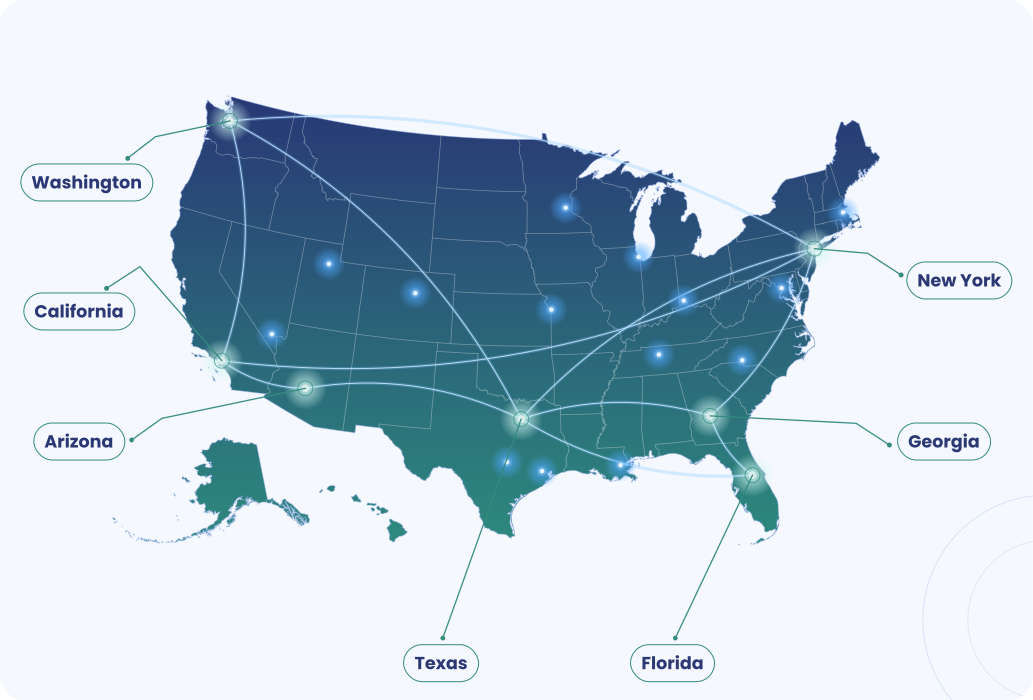
We Provide Dental Audit Services in All 50 States

 AUDIT REPORTING
24–48hr
 Audit Scope
- Compliance
- Payments
- Claims
- Ledgers
- more
 22%
 Recovery Opportunity


What Dental Teams Gain From a MedsDental Audit
Dental audits are useful when they explain why a claim, payment, write-off, or ledger balance went wrong and provide the team with sufficient evidence to correct the source of the error.


Dr. Treva Boyer DDS
Foundation Periodontics
“Our periodontal claims were not failing for one reason. The audit connected charting, attachments, frequency limits, and EOB language across the same cases. That showed us which denials needed appeal and which started inside our workflow. The correction list was specific enough for the team to fix the process instead of reworking claims one at a time.”



Dr. Chloe Goodwin DDS
PureGum Dental Health
“We found write-offs that looked normal in the ledger but did not match how several PPO claims had actually adjudicated. MedsDental traced the EOB, allowed amount, payment, and adjustment together. The audit gave us a list of balances to correct and a posting rule our billing team could use going forward.”


Dr. Cassidy Hessel DMD
AlignRight Orthodontics
“Our biggest surprise was not a coding issue. It was secondary coverage and patient balances. The audit found claims that stopped after the primary EOB, credits on older accounts, and responsibility posted too early. We finally had a clear path to reconcile those ledgers instead of treating every balance as a collection problem.”

Talk to Our Dental Audit Experts
Get a focused review of coding, claims, payments, denials, and compliance risk.
Tell us where revenue is getting stuck or where the numbers no longer reconcile. Our audit team traces the issue to the workflow, payer response, and account evidence behind it.
MedsDental supports general, specialty, and multi-location dental practices with findings your team can verify, prioritize, and act on.
 Coding & Documentation AuditMatch treatment to the claim.
 Denial Root-Cause AnalysisFind the why. Stop the repeat.
 Payment & EOB ReconciliationTrace every posted dollar.
 Ledger & Write-Off AuditTest adjustments and balances.
 1000+ PracticesNationwide Dental Support
 20+ PMS PlatformsSystem-Level Audit Support
 700+ SpecialistsDental Billing Expertise
 HIPAA-Conscious WorkflowProtected Audit Documentation
Audit The Detail. Recover The Revenue.



Questions Dental Practices Ask About Audits
Clear answers about dental billing, coding, A/R, write-offs, documentation, and revenue recovery.
A dental billing audit follows the financial path of the account: claim submission, payer response, EOB posting, write-offs, insurance A/R, patient balances, and collections. A coding audit focuses more narrowly on CDT selection, tooth or surface data, documentation, narratives, and attachments. Strong dental billing audit services connect both views so a coding or documentation error can be tied to the payment, denial, or ledger impact it created.
Internal teams know the practice well, but repeated workarounds can become normal and stop looking like exceptions. An external dental auditing service tests samples against source records, payer responses, ledgers, and written workflows. That independent view can expose unsupported write-offs, unresolved secondary claims, posting differences, recurring coding patterns, credit balances, or control gaps without replacing the people who run the process every day.
Most practices benefit from a comprehensive audit every six months, with smaller targeted checks in between. Frequency should still match claim volume, payer mix, staff turnover, specialty risk, and the number of locations. A new PMS, a major payer change, a sudden increase in denials, unusual credit growth, an acquisition, or a change in billing staff is also a practical reason to audit sooner rather than wait for the next routine cycle.
Yes. A dental audit should identify both risk and recoverable value. Common findings include unpaid claims, missed secondary billing, underposted insurance payments, incorrect PPO write-offs, unresolved alternate benefit downgrades, aging appeals, unapplied money, and credits that were never cleared correctly. The useful output is not just a total estimate; it is an account-level list showing the evidence, owner, next action, and recovery priority.
A useful audit should connect the chart, dental billing and coding, claim, payer response, payment, adjustment, insurance A/R, and patient ledger. It should also test eligibility, Coordination of Benefits, PPO write-offs, EOB reconciliation, credit balances, documentation, and transaction controls. Medical-path claims should be audited separately from routine dental benefit processing, since the claim logic and payer requirements differ.

Fewer denials. More clarity. That's the MedsDental promise.