


.webp)


Most dental offices open an EOB for one reason: to see how much the insurance company paid. That number matters, but it's only one line on the page. The rest of the EOB shows how the payer arrived at it, and that's usually where money goes missing.
A filling paid at a lower rate than you expected. A build-up that quietly paid nothing. A patient balance that doesn't match what your front desk quoted. None of these jump out unless someone reads past the total. Below, we go through an EOB section by section and point out what deserves a closer look.
What Is an EOB, and What Isn't It?
When an insurer finishes processing a claim, it sends out an explanation of benefits. The patient usually gets a copy by mail or through their member portal. Your office gets its own version, either a paper EOB or an electronic remittance advice (ERA) sent in the HIPAA-standard 835 format.
It isn't a bill. Patients mix this up all the time, so it helps when your front desk can explain the difference in a sentence. For your office, the EOB is something more useful: a line-by-line record of what the payer did, which you can check against what you billed and what your contract says you should be paid.
An EOB at a Glance
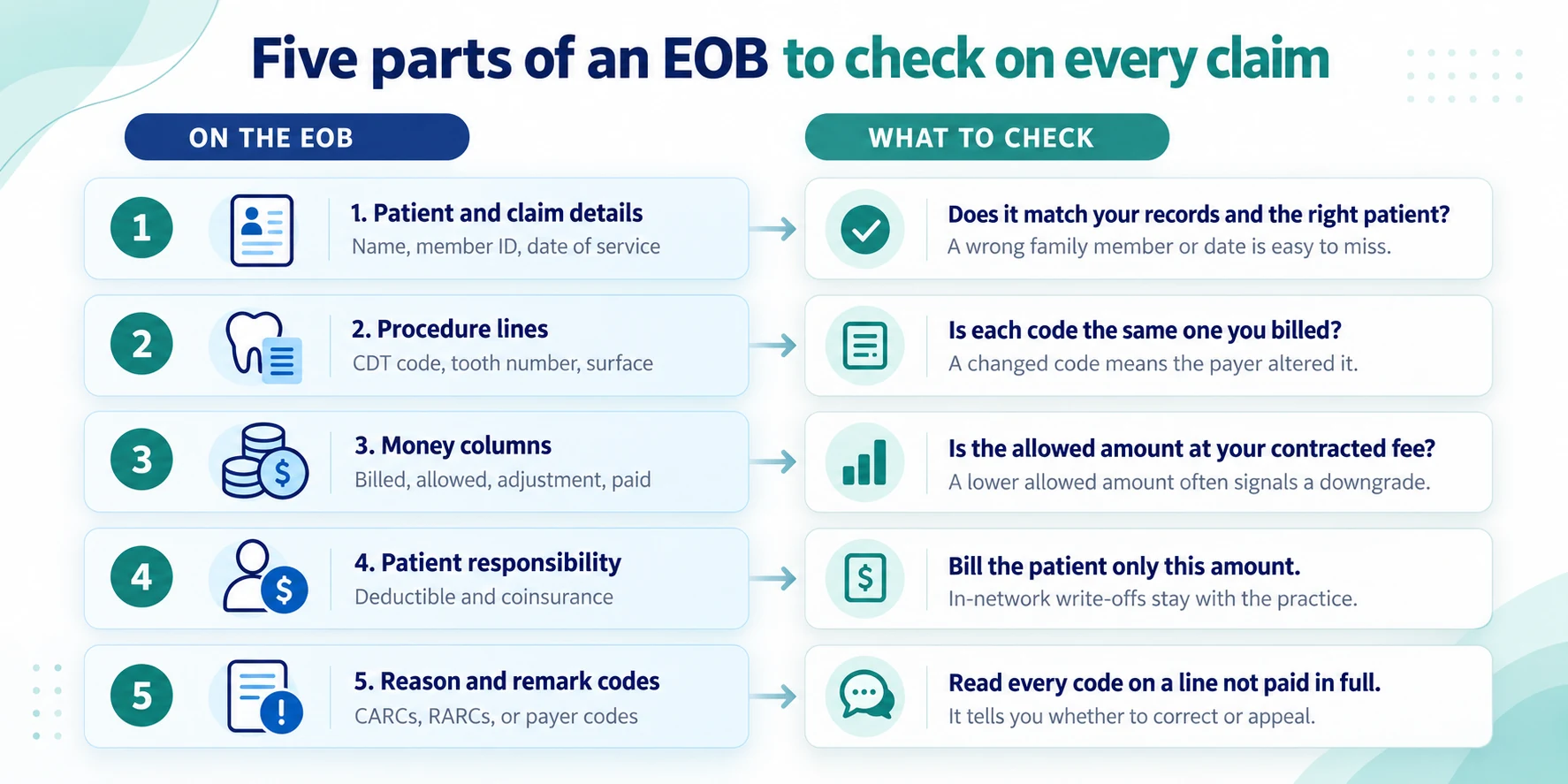
Every EOB looks a little different depending on the payer, but these five parts are almost always there. Work through them top to bottom and you'll catch most problems before they cost you.
Reading the EOB Line by Line
Start at the top. Check the patient name, subscriber, member ID, and date of service against your records. A wrong date, or a claim processed under the wrong family member, is easy to miss and annoying to fix later.
Then go procedure by procedure. Each line should show the CDT code you billed and the tooth number or area. If the code on the EOB isn't the code you sent, the payer changed it, and you need to know why.
The money columns are where most of the reading happens:
- Billed amount: your full fee for the procedure
- Allowed amount: the most the plan recognizes for it
- Contractual adjustment: what you write off as in-network
- Deductible and coinsurance: the patient's share under their plan
- Paid amount: what the insurer is actually sending
- Patient responsibility: what you can bill the patient
Last come the reason and remark codes. Electronic remittances use standard Claim Adjustment Reason Codes (CARCs) and Remittance Advice Remark Codes (RARCs), while paper EOBs often use the payer's own codes with a key on the back. Those codes explain anything that wasn't paid in full, so don't skip them.
Red Flags Worth Stopping For
Some problems look like normal adjustments unless you know what you're looking at.
Downgrades are the most common. Many plans have an alternate benefit clause, so a posterior composite filling might be paid at the amalgam rate, or a crown at the rate for a cheaper material. The EOB usually shows this as a lower allowed amount plus a remark code. Whether you can bill the patient the difference depends on your contract and your state's rules, so check before that statement goes out.
Bundling is another one. The payer may fold one procedure into another, like a core build-up into a crown, and pay nothing for the second line. Sometimes that follows the plan's rules. Sometimes it doesn't, and it's worth an appeal.
Also keep an eye out for:
- Frequency denials on cleanings, X-rays, or exams
- Allowed amounts below your contracted fee schedule
- Denials for missing attachments you did send
- Coordination of benefits holds waiting on other coverage
- Payments applied to the wrong patient or date
What to Do Once You've Read It
Post the payment and adjustments exactly as the EOB shows them, line by line. Lumping everything into one entry makes it nearly impossible to spot patterns later.
Bill the patient only what the EOB lists as their responsibility. If you're in network, the contractual write-off is yours to absorb, and billing the patient for it can put you in breach of your contract.
Then deal with anything that looks wrong. A clerical problem, like a wrong tooth number, usually needs a corrected claim. A dispute over coverage, a downgrade, or a missing attachment usually needs an appeal, and appeal windows don't stay open forever. Keep a simple log of the reason codes you see most. If one keeps showing up every month, the fix probably belongs at the front desk rather than in another appeal.
How MedsDental Can Help
Reading every EOB carefully takes time, and in a busy week it's usually the first thing to slide. Our dental billing solutions can take EOB and ERA review, payment posting, and follow-up on underpaid claims off your team's plate. When a denial needs to be challenged, our claim appeals team builds the case.
To keep the same problems from coming back, our dental coding services and dental audit services look at what's causing them in the first place. Oral surgery practices also get medical billing for oral surgeons, which covers the medical EOBs that come with cross-coded claims.
Stop Leaving Money on the EOB
Every EOB that goes unchecked is a chance for an underpayment to slip by. MedsDental can review a batch of your recent EOBs and show you what's worth a second look.