Every Minute Documented. Every Claim Accounted For.
Anesthesia billing leaves little room for missed details. A mismatch between the clinical record and the claim can delay payment for care already delivered. We connect anesthesia documentation with payer requirements, so your practice can submit defensible claims, catch payment discrepancies, and recover revenue without adding more work to your clinical team.
Dental anesthesia billing services manage claims for nitrous oxide, sedation, and general anesthesia. They cover benefit verification, prior authorization, time-based coding, and processing dental anesthesia claims. When medical necessity or the treatment setting requires a case to go to the medical plan, dental anesthesia medical billing services apply medical anesthesia codes, time records, and supporting documentation.
Outsourced Dental Anesthesia Billing Services
Why should a practice outsource dental anesthesia billing services?
Anesthesia claims often fail for reasons general billing staff overlook, such as incomplete start and stop times, a sedation code that doesn’t match the documented level, unclear dental versus medical benefits, and prior authorizations never requested. Whereas a dedicated anesthesia RCM service gives your practice specialists in anesthesia coding and payer rules, so claims go out supported and fewer end up as write-offs.
Verified Time Records
Fewer Coverage Denials
Reduced Write-Offs
Our Dental Anesthesia Billing Services
What Do Our Dental Anesthesia Billing Services Include?
Our team keeps verification, time-based coding, prior authorization, and payer follow-up aligned for every sedation level, whether the claim bills to dental or medical.
MedsDentalSmart Billing. Healthy Practice.
01
Dental Anesthesia ClaimsProcessing
We prepare each claim from the dental anesthesia record, matching start and stop times, the documented sedation level, and the rendering provider before filing, so the claim reflects the case exactly as performed.
Time Increments
Each started 15-minute increment reported for time-based codes.
Evaluation Coding
D9219 reported for moderate or deeper sedation evaluations.
Claim Status Follow-Up
Pending and rejected anesthesia claims tracked to resolution.
99%Clean claim rate
15 minBilling increments
Start/stop times verifiedProvider confirmed
02
Dental AnesthesiaInsurance Verification
We run anesthesia insurance verification before every case, confirming sedation coverage, procedure limits, age rules, and authorization requirements. We also offer anesthesia credentialing services to keep providers enrolled with each payer they bill.
Benefit Carve-Outs
Plans that exclude anesthesia or route it to a separate plan are identified.
Prior Authorization
Requests filed where payers, including Medicaid, require them.
Dental or Medical Benefit
Both plans checked for possible medical crossover.
2 plansDental & medical checked
3 checksCoverage, limits, auth
Coverage confirmedAuthorization tracked
03
Dental AnesthesiaCoding
Our certified coders select dental anesthesia CDT codes from the sedation level and route in the anesthesia record. For implant surgery under sedation, anesthesia is coded separately and coordinated with our dental implant billing service.
Deep Sedation & General Anesthesia
D9222/D9223, or D9224/D9225 when an advanced airway is used.
Moderate Sedation
D9239/D9243 IV, D9245 enteral, D9246/D9247 non-IV parenteral.
Minimal Sedation & Nitrous
D9244 single enteral drug, D9230 for nitrous alone.
98%Coding accuracy
700+Certified coders
Current CDT alignedRecord matched
04
Dental AnesthesiaDenial Management
We trace each anesthesia denial to its cause, whether it’s missing start and stop times, a sedation level the record doesn’t support, an excluded procedure, or a missing authorization, then correct it, appeal it, or move it to patient billing.
Root-Cause Review
Denials sorted into coding, documentation, coverage, and authorization causes.
Appeal Preparation
Customized appeals with anesthesia records and medical necessity support.
Appeal Tracking
Deadlines and payer responses monitored.
48 hrsDenial review
22 daysAverage A/R
Appeals filedCauses logged
05
Dental AnesthesiaA/R Recovery
We follow up on every unpaid anesthesia claim, starting with those closest to their filing or appeal deadline, so your dental accounts receivable stays current, whether claims sit with dental or medical plans.
Aging Claim Review
Open claims sorted by payer and how long they’ve been open.
Separate-Provider Claims
Medical sedation claims (99155 to 99157) followed up with medical payers.
Performance Reporting
Anesthesia collections, denials, and A/R trends reviewed regularly.
22 daysAverage A/R
2 pathsDental and medical
Aging claims prioritizedA/R monitored
06
Dental AnesthesiaPayment Posting
We post every anesthesia payment, including those recovered through follow-up and appeals, against the codes and time units billed, and send any short-paid time or downcoded sedation levels back to A/R follow-up.
Unit-Level Posting
Payments matched to each billed code and time unit.
Medical Anesthesia Posting
00170 payments checked against base and time units.
Underpayment Review
Short-paid time, unexpected adjustments, and unsupported downcoding flagged.
Line-levelPayment matching
24–48hPosting Turnaround
Units reconciledRecoveries posted
Protect Your Anesthesia Revenue Before Claims Need Rework
Work with specialists who catch sedation-level, time, and payer-rule errors before filing, so corrections and resubmissions don’t hold up anesthesia revenue.
Sedation Claims Approved+30%Anesthesia Denials Reduced38%Time Units Recovered+24%
Right Level. Right Route. Right Time.
Dental AnesthesiaCoding Services
We deliver documentation-driven dental anesthesia coding that matches each CDT code to the sedation level, route of administration, airway use, and anesthesia time recorded in the clinical record, reducing denials and downcoded claims.
Sedation Level & Route Coding
We code the sedation level the provider documented, not the one planned, since current CDT codes separate minimal sedation from moderate sedation coded by enteral, non-IV parenteral, or IV route.
Airway & General Anesthesia Coding
When deep sedation transitions into general anesthesia with an advanced airway, we report D9222 and D9223 for the earlier portion and D9224 and D9225 for the time the airway is in place.
Anesthesia Time Documentation
We count time from when the provider starts anesthesia and monitoring in continuous attendance until the patient can safely be left with trained staff, reporting each started 15-minute increment from documented times.
Bundling & Medical Code Accuracy
We keep nitrous inside the sedation code when co-administered, report D9219 for moderate or deeper sedation evaluations, and apply CPT anesthesia codes with ASA physical status modifiers where medical payers require them.
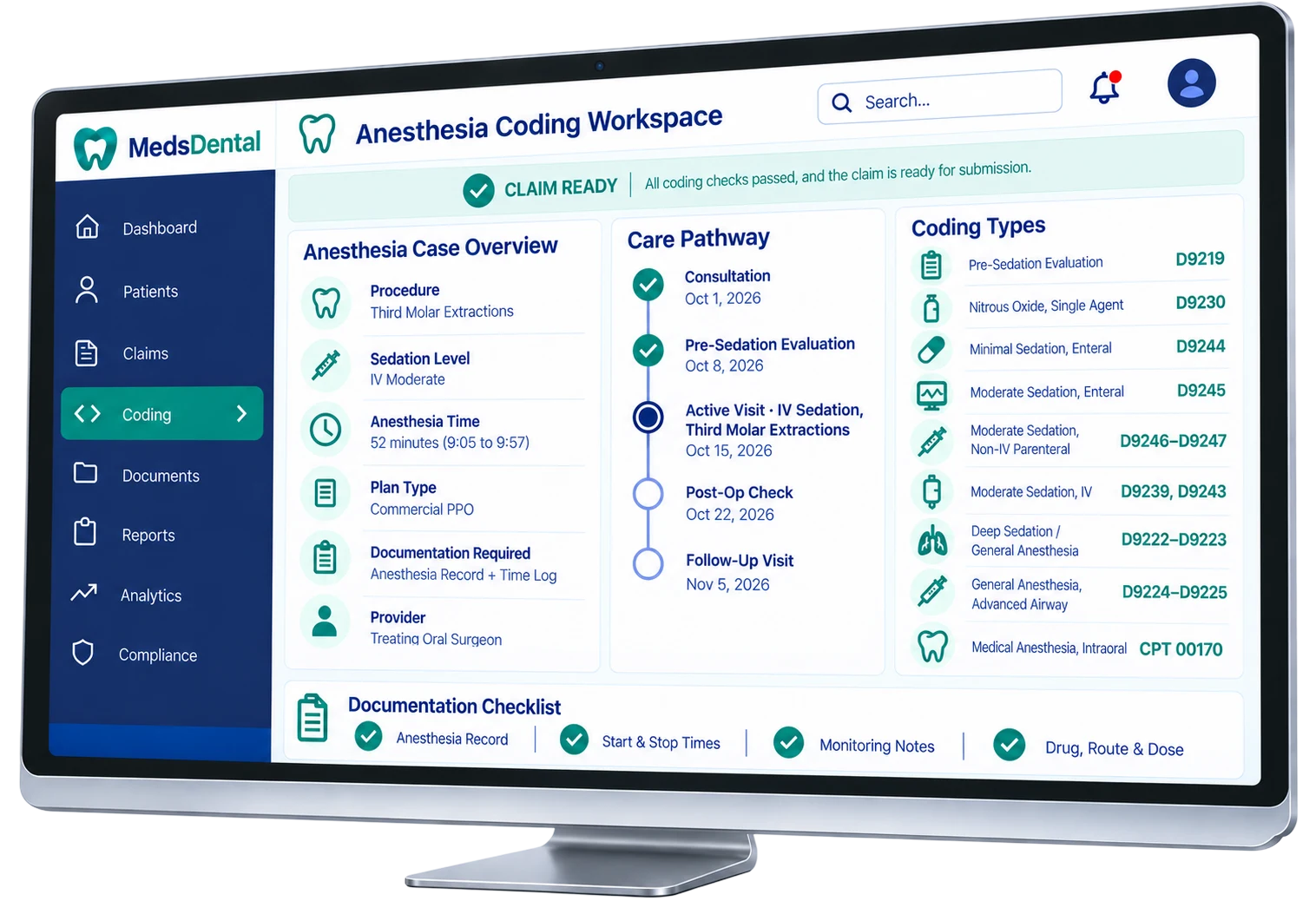
CLAIM READY
All coding checks passed. D9239 × 1 and D9243 × 3 ready to file.
Coding Validation
Sedation Level & Route Match✓ Valid
Drug & Dose Check✓ Valid
4 Time Increments✓ Verified
Nitrous Bundling✓ Confirmed
Overall StatusClaim Ready
Coding Accuracy
98%
Documented level, coded right.Last 30 Days
Record-to-Code Match
Every anesthesia code reflects the level, route, and time documented.
Time Increments Verified
Each started 15-minute increment is supported by the record.
No Double-Coded Nitrous
Nitrous stays inside the sedation code when co-administered.
Coded for the Right Plan
CDT or CPT coding matched to the plan that pays.
Why Choose MedsDental
Why Choose MedsDental for Dental Anesthesia Billing?
AI-assisted record review and certified specialists that turn documented sedation time into accurate, well-supported claims.
Coded From the Record.Measured by Payment.
Anesthesia claims rarely fail because the care was wrong. They fail because a start time is missing, the sedation level doesn’t match the code, nitrous was billed twice, or the payer needed an authorization nobody requested.
MedsDental uses AI-assisted review to scan anesthesia records for missing times, documentation gaps, and code mismatches. A certified specialist then confirms the coding, prepares authorization and medical necessity support, and routes each claim to the dental or medical payer.
Our dental sedation billing team then posts every payment against the units billed, so short-paid time is caught and followed up instead of disappearing into write-offs.
HIPAA Compliant
Time-Record Audits
Dental & Medical Claims
Anesthesia Billing Built on Coding Precision and Compliance
HIPAA-compliant anesthesia billing that safeguards patient records, applies accurate coding, and checks every claim against applicable payer documentation requirements.
HIPAA Compliant
Anesthesia records and billing data protected under HIPAA rules, with signed business associate agreements.
ISO 27001 Aligned Security
Security practices aligned with ISO 27001 for access control, risk management, and data protection.
AAPC-Certified Coders
Certified coders trained in anesthesia coding, time increments, modifiers, and payer rules.
Current CDT Anesthesia Coding
Coding kept current with each annual CDT update, including the latest sedation and advanced airway codes.
CDTCPTICD-10
CDT, CPT & ICD-10 Proficiency
Dental codes, anesthesia CPT codes, and ICD-10 diagnoses matched to the right payer and medical necessity.
PMS & EHR Integration
Billing handled inside your PMS or EHR through secure, role-based access.
Anesthesia Benefit Verification
Benefits, authorization rules, and medical necessity requirements checked before the case, not after the denial.
Claim Audit & Compliance Checks
Start and stop times, drug records, and airway details reviewed before submission.
Practice Types We Serve
Anesthesia Billing for Practices of Every Size and Case Volume
Whether you run a solo office, a growing group, or a multi-location organization, our outsourced dental anesthesia billing services adjust to your sedation volume and payers.
Solo & Small Practices
Mobile Anesthesia Providers
Family Dental Practices
Multi-Location Dental Groups
Hospital & ASC Dental Programs
Community Dental Clinics
Growing Startup Practices
High-Volume Dental Offices
Case Study
IV Sedation Claim Recovery
“We documented every sedation case carefully, but our claims didn’t show it. Once time records and drug details were checked before filing, resubmissions nearly disappeared.”
Dr. Ashton Mraz, DDS
Practice Owner At SereneSmile Anesthesia Group
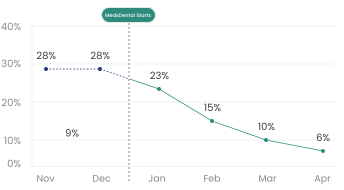
IV Sedation Denials Reduced From 28% to 6%
THE CHALLENGE
SereneSmile Anesthesia Group was providing IV moderate sedation and deep sedation for surgical and anxious patients, but a large share of D9239/D9243 and D9222/D9223 claims were denied or delayed. The sedation was clinically supported, but claims were leaving without the time records, sedation-level documentation, or drug details payers needed.
The team spent hours answering records requests, resubmitting corrected claims, and chasing increments that were short-paid or denied outright.
OUR SOLUTION
MedsDental built an anesthesia-specific pre-billing check. Before submission, each claim was matched against the documented sedation level, start and stop times, drug and dose record, and the number of 15-minute increments the record supported.
Payer-specific requirements, including medical necessity narratives where payers asked for them, were mapped into the workflow, so supporting records traveled with the first submission instead of after a denial.
Times loggedSedation level matched
Drug record attachedNarrative on file
THE RESULT
IV sedation and deep sedation claims began reaching payers with the documentation needed to support the time billed. Fewer claims came back for records, increments were paid as documented, and anesthesia A/R moved faster with far less resubmission work.
What Changed for Practices After Switching to MedsDental
Anesthesia billing depends on accurate time records, documented sedation levels, and payer-specific requirements. Here’s how practices describe the difference MedsDental makes in managing sedation claims.
Dr. Elsa Monahan, DMD
NovaPulse Anesthesia Partners
“Our longer IV sedation cases kept coming back short-paid because the extra time increments weren’t captured. MedsDental now reviews our anesthesia records before filing, so every supported increment is coded and billed.”
Dr. Tyler Mann, DDS
Float Dental Sedation
“Our general anesthesia cases for patients with special health care needs often required coordination between dental and medical plans. MedsDental helps clarify payer responsibility, check authorization requirements, and submit claims with the appropriate supporting documentation.”
Dr. Garnett Blanda, DMD
At Ease Dental Care
“When the CDT sedation codes changed, we needed help updating our coding process for non-IV sedation cases. MedsDental reviewed the applicable codes and documentation requirements, helping us address coding errors that had been causing claim rejections.”
Outsourced Dental Anesthesia Billing Services
Let’s Strengthen Your Dental Anesthesia Revenue Cycle
MedsDental manages your anesthesia billing, including verification, authorization, coding, claims, payment posting, and A/R follow-up, so your team spends less time on billing issues and more on patient care.
Verification & Authorization
Anesthesia benefits, coverage limitations, carve-outs, and prior authorization requirements reviewed before the scheduled procedure.
Coding & Claim Submission
Sedation services coded from the anesthesia record, with claims prepared for the dental or medical payer that applies.
Payment Posting & A/R Follow-Up
Payments and adjustments reconciled against remittance details, with underpayments, denials, and aging claims investigated and followed up.
Dental Anesthesia Billing FAQs
What Practices Ask About Dental Anesthesia Billing
Clear answers on sedation coding, documentation, and dental versus medical coverage.
Time-based sedation is billed with one code for the first 15 minutes and a second for each additional 15 minutes, partial blocks included, while the provider stays in continuous attendance. That’s why errors usually involve missing stop times or increments added to non-time-based codes like D9245.
Payers commonly expect a pre-sedation evaluation with ASA status, signed consent, and an anesthesia record showing start and stop times, drugs with dose and route, sedation level, airway use, and monitored vitals, including capnography where required. Recovery and discharge notes complete the file.
Anesthesia may bill to medical when sedation is medically necessary, such as for young children, patients with special health care needs, or medical conditions, or when the procedure is medical, like jaw trauma. Prior authorization is often required, and many states mandate coverage for qualifying patients.
The mobile anesthesiologist bills separately under their own NPI, while the dentist bills the procedure. Depending on the plan, anesthesia is submitted as a dental claim with CDT codes or a medical claim with CPT codes such as 00170. And the provider must be credentialed with each payer.
Many plans limit nitrous oxide (D9230) by age or treat it as patient-paid, because it’s the lightest form of sedation, used for anxiety. Under CDT rules, it’s reported only when used alone, never with other sedation codes, and it isn’t time-based.
Many dental billing companies treat sedation as one more line item. As a dental and medical anesthesia billing expert, MedsDental treats it as a specialty, with current CDT rules, medical crossover, separate-provider billing, and increment-level posting that general billing teams often miss.
For Medicaid enrollees under 21, EPSDT requires states to cover medically necessary dental care, which can include general anesthesia. For adults, coverage varies by state. Approval usually depends on documented medical necessity, ability to cooperate, treatment extent, and setting, and many programs require prior authorization.
Deep sedation, general anesthesia, and IV moderate sedation are typically reported separately from the procedure. Nitrous oxide is not reported when given with other sedation, and local anesthesia is usually bundled. Payers apply their own edits, so confirm policies and documentation before billing.
Every documented minute, billed with care. That’s the MedsDental difference.


 (516) 271-2958






 Sedation level















 CLAIM READY





 HIPAA Compliant
 Time-Record Audits
 Dental & Medical Claims

































 Times logged


 Before