





If you run a dental office, billing compliance is probably somewhere on your list of worries. It's not that dental teams are careless. The rules are just scattered across HIPAA, payer contracts, state law, and a CDT manual that changes every January, and nobody has time to read all of it.
Most problems start small. Someone codes a periodic exam as comprehensive because that's how it was always done. A perio chart from last year gets used to justify this year's scaling and root planing. Multiply that by a few hundred claims and you've got a refund demand waiting to happen. Below is a practical look at what the rules require and how to keep your office on the right side of them.
What Does Billing and Coding Compliance Mean for a Dental Practice?
At its simplest, a compliant claim tells the truth. The code matches what happened in the chair, the chart backs it up, and the fee is what you actually charge. Patient information stays protected the whole way through.
It gets complicated because every payer wants things done its own way. Your commercial plans, your state Medicaid program, and the medical insurer you bill for a biopsy all ask for different paperwork and follow different frequency rules. And the target keeps moving. New CDT codes take effect every January 1, payers quietly update their policies mid-year, and staff come and go.
Which Regulations Apply to Dental Billing?
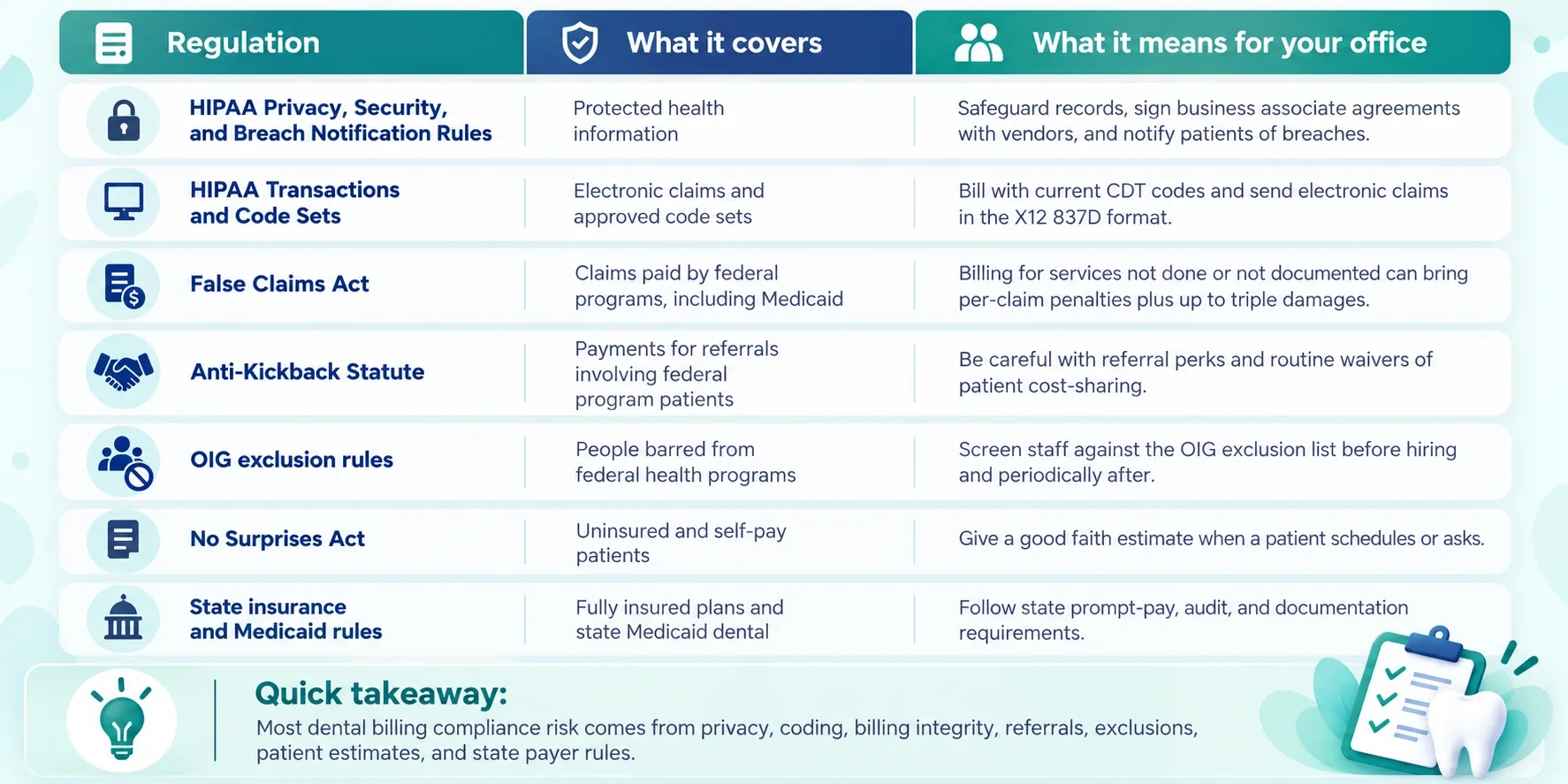
HIPAA is the obvious one. It covers how you store, share, and protect patient records, and it requires a business associate agreement with anyone outside the practice who handles them, your billing company included. It also sets the rules for electronic claims, which is why you have to use current CDT codes and the X12 837D format.
If Medicaid patients are on your schedule, take the False Claims Act seriously. Billing for work that wasn't done, or that the chart can't support, can bring penalties for each claim plus up to triple the government's losses. The Anti-Kickback Statute is the other big federal rule, and it's the reason referral perks and routinely waiving what federal program patients owe are risky.
Then there are the rules people forget. Anyone on the OIG exclusion list shouldn't be working on anything billed to federal programs, so check new hires and recheck staff from time to time. Uninsured and self-pay patients are owed a good faith estimate under the No Surprises Act. And every payer contract you've signed adds its own requirements on top of state law.
Where Do Dental Practices Most Often Go Wrong?
Perio is a classic trouble spot. Scaling and root planing (D4341 or D4342) needs current pocket depths, signs of bone loss, and a diagnosis in the chart. Without them, an auditor sees an expensive cleaning, and that's a pattern payers go looking for.
Exams cause problems too. If the note reads like a periodic exam but the claim says comprehensive, it won't survive a review. The same goes for splitting a single procedure into several codes because it pays better.
A few others that come up again and again:
- Clinical notes that don't match the code
- Copays waived as routine, insurer never told
- Insured patients charged more than self-pay patients
- Old CDT codes still used after January
- No one checking staff against the exclusion list
How Can Your Practice Stay Compliant?
You don't need a legal department to do this well. The HHS Office of Inspector General's General Compliance Program Guidance boils an effective program down to seven elements, and a dental office can cover all of them with a bit of discipline.
Get your policies on paper, covering coding, documentation, fees, and privacy, and keep them short. Pick one person to own compliance, often the office manager or lead biller, and give them real time for it. Train the whole team once a year, and don't leave out the dentists and hygienists. Their notes are what the codes stand on.
After that, it's follow-through. Make it easy for staff to flag a billing question without feeling like they're accusing someone. Hold every provider to the same rules. Audit on a calendar, not just when something feels wrong. And when you find a mistake, fix it and give back what you shouldn't have been paid.
Don't sit on that refund. Federal law generally gives you 60 days after identifying a Medicare or Medicaid overpayment to report and return it. Wait longer, and an honest mistake can turn into a False Claims Act problem.
How Often Should a Dental Practice Audit Its Claims?
Nothing in the law sets a schedule. Once a year is the minimum most practices should aim for, and if you have several providers or a lot of Medicaid patients, quarterly is safer.
The process isn't complicated. Pull a random batch of claims, open each patient's chart, and check that the code, the notes, and the attachments all agree. It's smart to do an extra round after a new dentist joins, after a software switch, or when the same denial keeps landing on your desk.
It helps to have someone outside the office do it, because the person who coded a claim tends to read the chart the same way twice. Our dental audit services give you that second set of eyes, plus findings your team can actually act on.
Does Oral Surgery Add Compliance Risk?
It does. Many oral surgery practices bill two kinds of insurance, sometimes for the same patient in the same week. Dental work goes on the ADA form with CDT codes. Medical work goes on a CMS-1500 with CPT and ICD-10-CM codes, and medical payers judge it by their own rules.
There's nothing wrong with billing medical insurance for an impacted third molar or a biopsy when it's medically necessary and the chart says so. The risk shows up when a claim goes to the medical plan without a diagnosis to support it, or when both plans get billed as primary. Our medical billing for oral surgeons keeps each claim pointed at the right payer, with the records to back it up.
How MedsDental Supports Your Compliance
Most dental practices can't justify a full-time compliance officer, and most don't need one. What they need is billing done carefully, by people who know the rules.
That's how we work. Our dental coding services check codes against the chart and keep CDT, CPT, and ICD-10-CM coding current. Our dental billing solutions put compliance checks into the daily routine, from eligibility verification to claim submission. If a payer denies something anyway, our claim appeals team answers with documentation.
What your office gets:
- Codes checked against clinical notes before submission
- New CDT codes in place before January claims
- Regular audits with written findings and fixes
- Patient records handled under HIPAA safeguards
- Dental and medical claims kept separate for surgeons
How Should Your Practice Respond to a Payer Audit?
An audit letter usually asks for records on a list of patients and dates of service, with a deadline to send them. Read it slowly, mark the deadline, and be clear on exactly what's being requested before anyone starts pulling charts.
Send what was asked for, complete and organized, and nothing more. Before it goes out, compare each record with the claim it supports. If that review turns up a coding error, leave the original chart entries alone. A late addendum has to be clearly dated as one, and edits made after an audit request can look worse than the mistake itself. This is a good moment to bring in a compliance advisor or healthcare attorney.
Payers don't always say why they picked you. Unusual billing patterns compared with similar offices, a sudden jump in one procedure code, or a patient complaint can all draw a closer look. Regular internal audits are the best preparation, because you'll already know where your weak spots are.
- Mark the response deadline the day the letter arrives
- Send only the records the payer requested
- Never change existing chart entries after the fact
- Keep a copy of everything you send
- Get expert help if errors turn up
Get a Clear Picture of Your Billing Compliance
Your team should be spending its time on patients, not reading payer bulletins. MedsDental can look at how your billing works today and give you a straight answer on what's fine and what needs fixing.