

 (516) 271-2958


Dental Accounts Receivable Management Services
What Our AR Management Covers
 Claim Follow-Up & Underpayment Recovery
- Aging AR Review & 90+ Day Claim Cleanup
- Denial Rework, Appeals & Resubmission
- Patient Balance Collection & Follow-Up
- Unapplied Payment & Credit Cleanup
- Monthly AR Reports & Days in AR Trends
 Aging Recovery
 Denial Rework
 Patient Collections
 AR Reporting

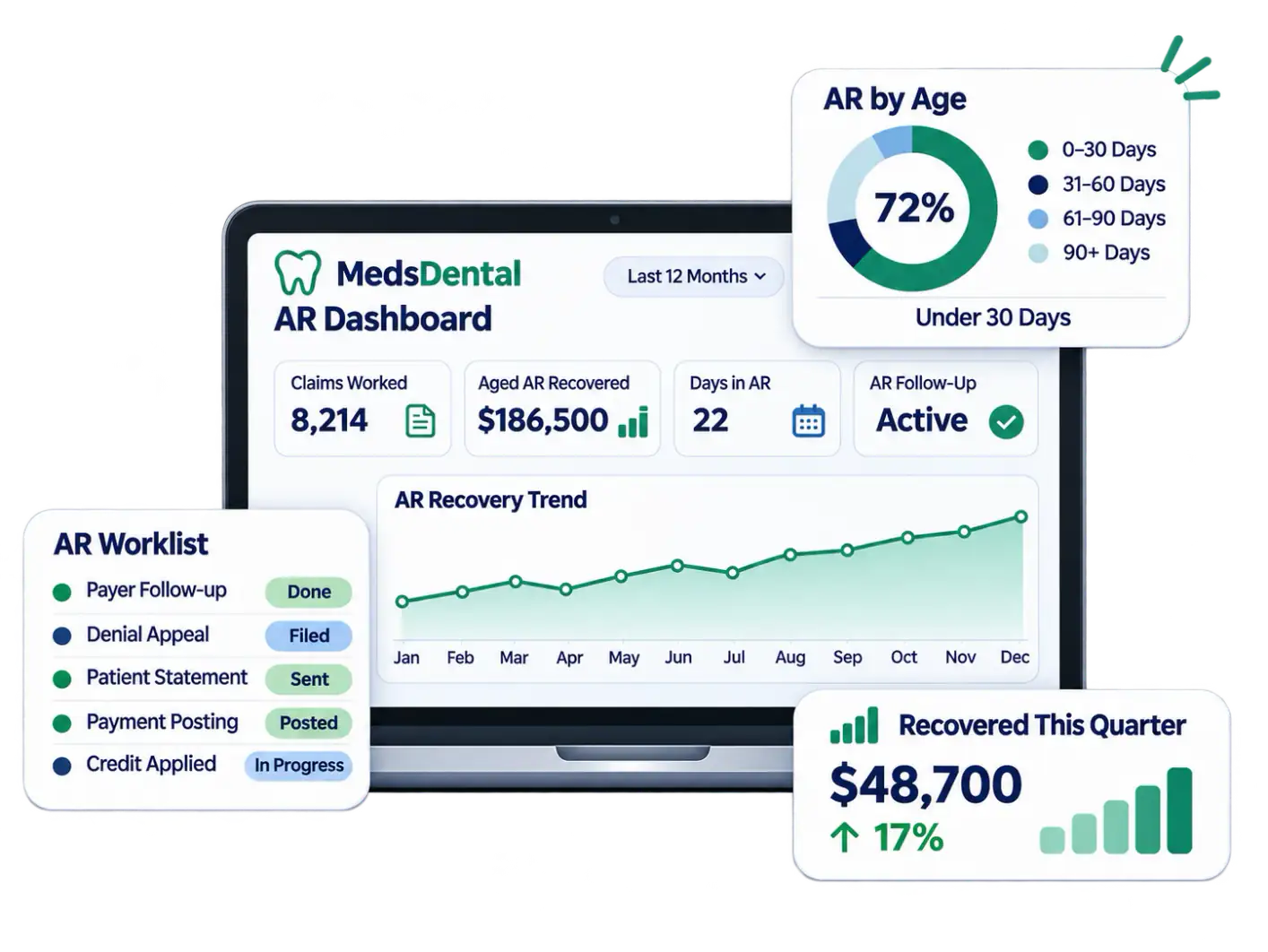
Our Core Strengths


Claims

Specialties

Served

Expertise

Billing
Claim Rate
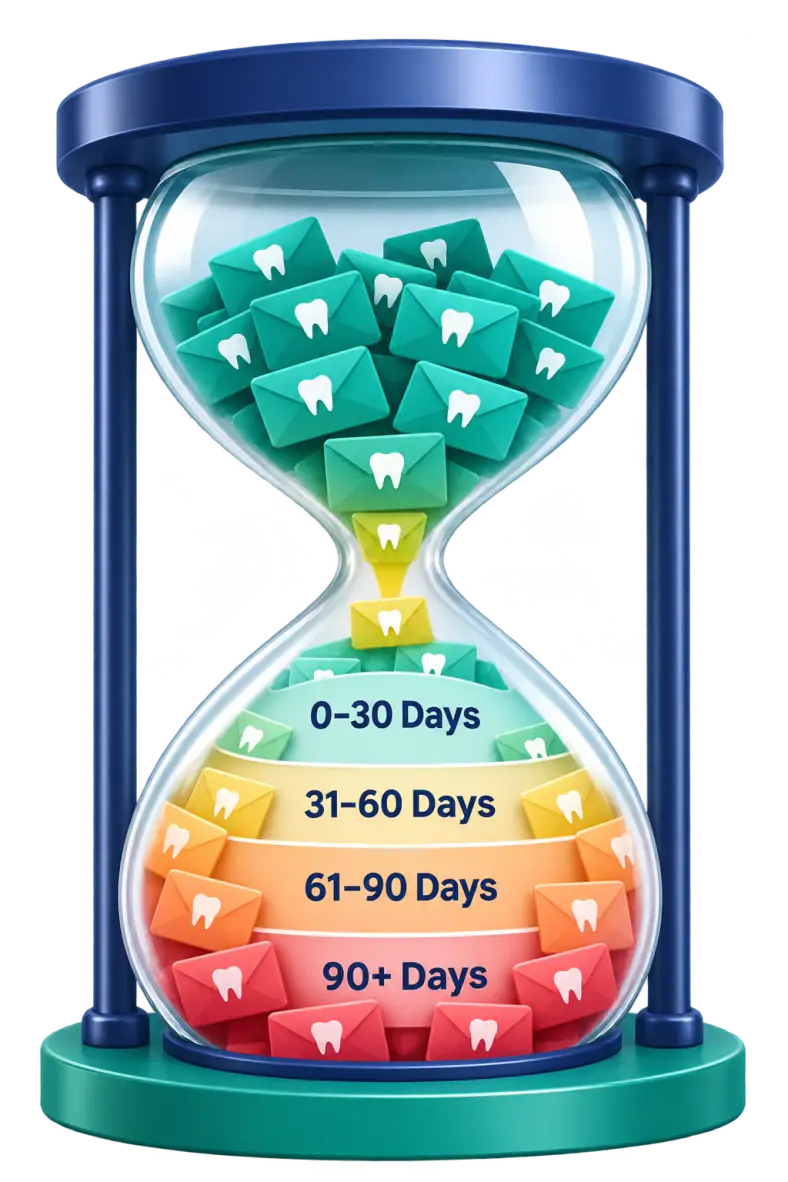
How Do You Know Your AR Is Aging Out?
Many practices don’t realize their dental accounts receivable is slipping until the aging report is already crowded with claims over 60 days. By then, the cause is usually something small that went unchecked weeks earlier. Here are six signs to look for.
Claims go quiet after submission, and no one owns the next call. Without a set routine for outstanding insurance claims follow-up, a quick status check becomes a 60-day problem.
Some EOBs apply an allowed amount lower than the fee in your PPO contract. When nobody checks the EOB against that fee schedule, the shortfall gets buried in the contractual adjustment and forgotten.
Denials get worked whenever someone finds a free hour. But many sit untouched until the payer’s appeal window closes, and the balance becomes a write-off.
Statements go out, but nobody follows up on the unpaid ones. Small deductible and coinsurance balances age until they’re written off as bad debt, pushing up your dental bad debt percentage.
Payments sit unapplied as unallocated credits, or get posted to the wrong procedure. Together, these errors leave a ledger showing balances no one owes while hiding real ones still due.
The primary pays, the claim looks finished, and the secondary never goes out. The remaining amount lands on the patient or gets written off, even though a second payer owed part of it.
Spot it early. Work it fast. Collect what’s owed.
What Is Dental Accounts Receivable Management?

Dental accounts receivable management is the process of tracking and collecting money a practice is owed for completed care from insurance carriers and patients. It involves monitoring balances by age, following up on unpaid claims and statements, resolving denials, and posting payments until each balance is collected or properly closed.
Insurance Accounts Receivable vs. Patient Accounts Receivable
The two balances come from different sources, age at different speeds, and need different follow-up.
Insurance Accounts Receivable
Reimbursements the practice still expects to receive from payers on submitted claims. They’re worked through status checks, denial rework, appeals, underpayment review, and secondary billing. They age based on payer response times and filing and appeal windows.





Patient Accounts Receivable
Balances that patients owe once insurance processes the claim, including deductibles, coinsurance, and non-covered services. They’re collected through statements, reminder calls, and balance follow-up. They age based on patient follow-through, so early contact matters most.
- Claim Submitted
- Payer Adjudicates
- EOB Posted
- Patient Share Billed
- Balance Closed


What Our Dental AR Management Services Include
Focused follow-up for open claims, denials, short payments, patient balances, and unapplied credits.
-

Insurance AR Follow-Up
Claims that nobody checks after submission tend to stall quietly. That’s why we run outstanding insurance claims follow-up on a fixed schedule, confirming each claim’s status with the payer and assigning the next action before it slips into an older bucket.
 Payer status checks
- Records and attachment requests
 Timely claim resubmission
-

Aged Claim Recovery
Older claims often get written off because chasing them takes more time than an in-house team can spare. Through our dental accounts receivable recovery services, we rank them by deadline and value, then fix what stalled each one.
 Filing and appeal deadline review
- Claim history investigation
 Corrected claims and appeals
-

Denial Management & Appeals
Denials that sit in a pile lose their appeal windows one by one. We review each denial to find its cause, correct what the claim needs, and prepare appeals with documentation your providers supply and, when required, sign.
- Denial reason review
- Appeal preparation
 Recurring denial tracking
-

Underpayments & Secondary Claims
Short payments and unfiled secondary claims can go unnoticed because they don’t always trigger formal denials. So we compare each EOB’s allowed amount against your contracted fees, dispute supported shortfalls, and file secondary claims with primary payment details under COB rules.
 Contracted fee comparisons
 Underpayment disputes
- Secondary claims and COB
-

Patient Balance Follow-Up
Small patient balances often go unchased until they turn into bad debt. Through our dental patient balance collection services, we confirm each patient’s share after primary and secondary insurance processing. Then we send clear statements and follow up on unpaid balances.
- Patient responsibility checks
- Itemized patient statements
- Scheduled payment reminders
-

Payment Posting & Reconciliation
Payments posted late or to the wrong procedure make the aging report unreliable. We post insurance remittances and patient payments line by line, then resolve unapplied payments and unallocated credits, so balances reflect what’s truly owed.
- ERA and EOB posting
- Unapplied credit investigation
- Write-off and adjustment review
Give every unpaid balance a clear next step.

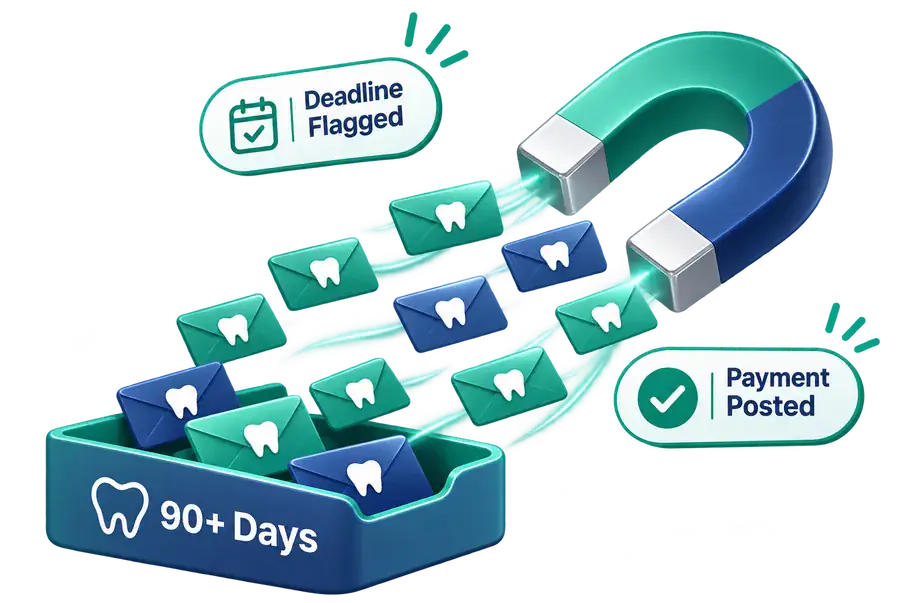
Don’t Let Your Aging Claims Turn Into Write-Offs
Hand off your oldest claims to our AR team, and we’ll work each unpaid balance by deadline and value while there’s still time to file or appeal.

How We Turn Your Dental AR Report Into a Recovery Plan
An AR aging report shows how long each balance has been open, but not why it’s still unpaid. That’s why we run dental AR aging report analysis to identify which balances can be collected, which need further investigation, and what action each one requires.
Here’s how it works:
-
 Reason
Each balance is tagged with its likely cause, and we route recurring issues to our dental A/R audit services.
-
Action
That cause determines the next step, whether a status check, correction, appeal, or patient follow-up.
-
Status
Each action is logged with a date, so you can see what’s moving and what’s resolved.
Tag it. Work it. Track it.
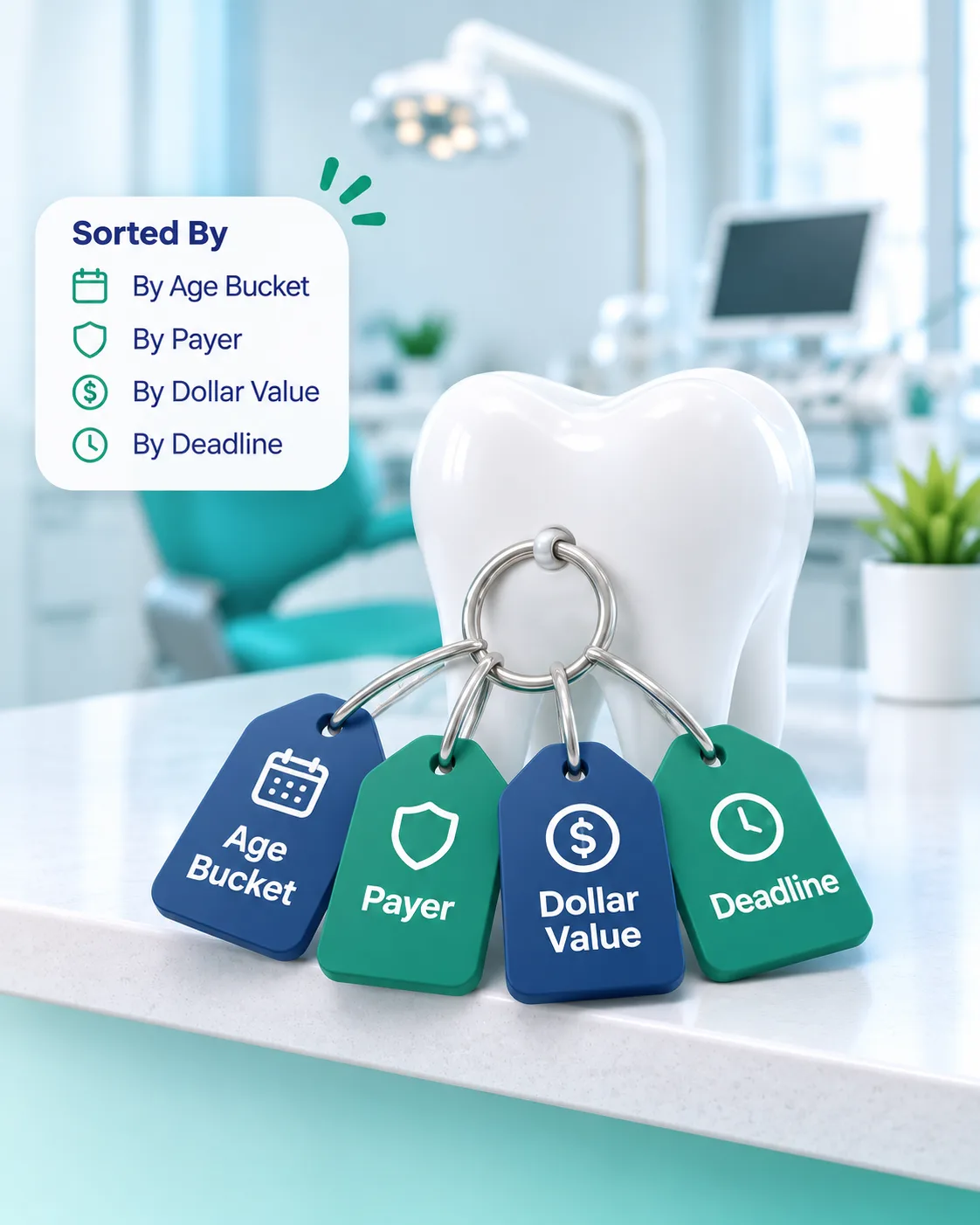
Our Six-Step Dental AR Recovery Process
When you outsource accounts receivable management to MedsDental, we first confirm what’s truly owed, then follow a systematic process to work down existing AR and catch new claims before they stall.
-
01
Connect and Set a Baseline
We sign a business associate agreement (BAA), then work in your PMS, clearinghouse, and payer portals through user access your team sets up. We pull a baseline of total AR, days in AR, and the share over 90 days, which becomes the starting point for measuring progress.
Result: A baseline AR snapshot
-
02
Verify the Ledger First
Old aging reports, especially after switching to a new PMS, often include paid claims still showing open, payments never applied, and duplicate entries. We reconcile those first, so follow-up starts with balances that are actually owed, not money already in the bank.
Result: An aging report you can trust
-
03
Agree on the Rules
Some balances need a practice decision before anyone works them. We confirm your write-off policy and adjustment approvals, small-balance rules, patient contact preferences, and which provider signs appeals, so every action follows your policy.
Result: Agreed rules for write-offs and appeals
-
04
Trace & Resolve Open Claims
Our dental accounts receivable management specialists check clearinghouse reports, payer portals, and claim history to find what’s holding each claim, then correct, appeal, or dispute it. Patients are billed only after all plans process the claim.
Result: Open balances in active follow-up
-
05
Post and Reconcile Recoveries
We record recovered payments from ERAs, EOBs, and patient receipts against each claim or account. Then we match each deposit to those entries. We check any overpayments or differences so the aging report shows the correct unpaid balances.
Result: Recovered payments matched to deposits
-
06
Report and Prevent Repeats
Each month, you get a report comparing days in AR, net collection ratio, and AR turnover against your baseline, along with denial patterns. We share repeat causes with your office and providers, so fewer new claims end up in older buckets.
Result: A monthly AR report with next steps


What Makes MedsDental a Trusted Dental AR Management Partner?
AR backlogs usually build from small gaps. These can include follow-ups that wait until someone has time, denials worked without finding the cause, short payments posted without a second look, and patient balances left sitting after the EOB arrives. But we offer dental accounts receivable solutions that replace those gaps with a set routine built on dental payer rules and your own practice policies, with one dedicated team accountable for your open balances.
When practices compare dental AR management companies, the real difference is visibility. You see each open balance with its cause, the last action taken, and its next follow-up date. That means fewer surprises for your office manager and more time with patients for your front desk, while open claims get status checks and follow-up between monthly reports.

-
 22Days in AR
-
 99%Net Collection
-
 20+PMS Platforms


8 Standards Behind Our Dental AR Work
-
We work with CDT codes, PPO fee schedules, and dental payer rules every day.
-
The same team handles your account, so follow-up doesn’t restart with new people.
-
We file secondary claims and clear COB holds, so balances don’t stall after the primary pays.
-
Our billing team tracks filing and appeal deadlines, with AI checks as a safety net.
-
We review every denial within 48 hours, then correct or appeal it with the records it needs.
-
We adjust or write off balances only under the policy your practice approves.
-
We work within Dentrix, Eaglesoft, Open Dental, and other major dental PMS platforms.
-
We compare aging, collections, and recovery against your starting baseline every month.

Dental AR Follow-Up for Every Specialty We Serve
Dental claims don’t stall for the same reasons in every specialty. Each has its own codes, documentation, and payer limits, so a claim that pays quickly in one may be delayed or denied in another over missing records or frequency limits. But we follow up with those rules in mind. Here’s how that looks across the 20+ specialties we support.
Root canal claims may need radiographs or clinical notes, which our Endodontic Billing Services team reviews before payer follow-up. On orthodontic accounts, we track installment payment cycles against remaining lifetime maximums, and for periodontal claims, we review current charting and the separate SRP and maintenance frequency limits.
Prosthodontic balances are worked with replacement clauses and placement dates in view, while pediatric claims are checked against state Medicaid and CHIP rules. When a general practice treats sleep apnea or TMJ, those claims may need a medical track, which is why we also offer General Dentistry Medical Billing. So when a balance stalls, our specialists know what to look for and what the payer will need next.
- Frequency Limits
- Clinical Attachments
- Lifetime Maximums
- Replacement Clauses
- Medical Crossover
Different codes. Different rules. One AR standard.
20+ DENTAL SPECIALTIES SUPPORTED


Specialty-aware follow-up for frequency limits, attachments, replacement rules, and payer timelines.
20+
SPECIALTY RULES · CONSISTENT FOLLOW-UP
Dental AR Support for Practices of Every Size

-

Solo Practices & Small Practices
-

Independent Practices
-

Family Dental Practices
-

Multi-Location Dental Groups
-

General & Cosmetic Dentistry
-

Community Dental Clinics
-

Growing Startup Practices
-

High-Volume Dental Offices

Don’t Change Your Software. Change How Your AR Gets Managed.
Our specialists handle AR follow-up, post payments, and document account activity directly in your existing software and payer portals.


















Monthly Financial Reporting for Dental Practices
Every month, you receive an accounts receivable report that shows where your money is, how fast it’s coming in, and what needs attention. It gives owners and accountants a reliable base for dental practice cash flow forecasting. A total AR figure tells you how much is owed, but not whether collections are healthy, so the report answers four questions.
-
How fast are we getting paid?
Days in AR is tracked against your starting baseline, and AR turnover shows how many times in a period receivables convert to cash.
-
How much of our production do we collect?
Gross and net collection rates show how well production turns into payments, and the AR-to-production ratio shows whether open balances are growing faster than the work you produce.
-
What is at risk?
Aging buckets show how balances spread over time, and anything over 90 days is flagged for follow-up before it slips further.
-
What did we lose, and what did we recover?
Bad debt percentage is reported next to amounts recovered after write-off. Balances carried over from your previous PMS are reconciled and tracked separately, so old data doesn’t distort current results.
Each report ends with next steps, so you know which balances to pursue first and where the process needs attention.
Schedule a Demo
Monthly AR Report
MedsDental · Reporting Period
DAYS IN AR01
22days
↓ 19 days vs. baseline
AR TURNOVER01
1.4x / month
↑ Faster than baseline
COLLECTIONS VS. PRODUCTION02
99%net
68%gross
AR-to-production ratio: 0.7, steady against monthly production
AGING DISTRIBUTION03
-
 0–30
58%
-
 31–60
21%
-
 61–90
11%
-
 90+
10%
 14 balances over 90 days flagged for follow-up
BAD DEBT04
1.2%
$3,480 recovered after write-off
LEGACY PMS BALANCES04
$12,640
Legacy balances tracked separately
 Next Steps
- Work the 14 claims over 90 days, starting with Delta Dental and MetLife.
- Resubmit 5 periodontal claims with updated charting.
- Send statements on 18 patient balances after secondary processing.
Dental AR Outsourcing Built on Secure Standards



Our HIPAA-compliant AR outsourcing follows recognized security controls that keep patient and payer data safe at every step.
We Manage Accounts Receivable for Dental Practices Across All 50 States



 Days in AR
22 days
 AR Scope
- Insurance AR
- Patient AR
- Denials
- Credits
- more
 12%
 Aged AR in Follow-Up


What Dental Practices Notice After Handing Off Their AR to MedsDental
Outsourcing AR changes the everyday details, like claims that finally get answered, credits that reconcile, and reports that show real progress. Here’s what practices noticed once a dedicated team took over their AR.

Dr. Hannah M. McLeod, DDS
Cedarline Advanced Dentistry
“Our 90-plus column kept growing because nobody had time to call payers. Then MedsDental stepped in, sorted the older claims by filing or appeal deadline and the reason each was unpaid, and worked through them on a set schedule. For the first time, I could see why each balance was still open and what was happening next. The monthly report made it easy to track what came in.”


Dr. Sydnee Murphy, DDS
Everden Dental Partners
“After switching software, our aging report stopped making sense. Paid claims still showed as open, credits sat unapplied, and some balances appeared twice. When we brought in MedsDental, they reconciled the converted ledger before chasing anything, so we weren’t calling payers about money we already had. Legacy balances are tracked separately now, and our accountant trusts the numbers again.”

Ima Kihn, Office Manager
Harborstone Dental Care
“I knew some PPO payments looked low but never had time to check them. Once MedsDental took over, they compared allowed amounts against our contracted fees and found shortfalls we had been writing off. They disputed the supported ones and filed eligible secondary claims we’d missed. With that handled, our staff stopped spending afternoons on hold, and patient statements finally matched their EOBs.”

Your Practice Did the Work. Let's Recover What's Owed.
Reaching out takes a few minutes. Here’s what to expect next.
-
Prompt Reply
Our team responds to every inquiry within one business day.
-
Dental AR Specialists
Speak with specialists who understand dental payer rules, aging claims, and AR follow-up.
-
A Plan Based on Your AR
We start with your aging report to identify outstanding balances, priorities, and what’s still collectible.
- 22 DaysAverage Days in AR
- 20+Dental Specialties
- HIPAACompliant Operations









What Practices Want to Know About Dental AR
Dental accounts receivable is commonly kept at or below about one month of production, an AR-to-production ratio near 1.0. Many consultants also aim for less than 10% of total AR to be over 90 days old. Targets vary by specialty and payer mix, so your own trend against a baseline matters more than any single number.
Read a dental AR aging report by separating insurance and patient balances, then checking what share sits past 90 days and which payers hold the most. Next, look for credit balances, unapplied payments, and claims with no recent follow-up, and compare the totals with last month’s. The goal is to find why balances are open, not just how old they are.
Dental patient AR is harder to collect because patients usually carry a larger share of the cost. Medical plans cap what patients pay with an out-of-pocket maximum, while most dental plans cap what the plan pays with a low annual maximum. Compared with accounts receivable for medical offices, dental balances also run higher, since major work like crowns is often covered at only 50%.
An unapplied payment is money posted to an account but not applied to a specific procedure or claim. The charge keeps aging as if it were unpaid while the credit sits separately, so the aging report shows old balances that were already paid. Unallocated credits can also hide overpayments that may need refunds, making AR both inaccurate and a compliance concern.
A dental practice should consider collections only after insurance has fully processed, the balance is verified, and the patient has received several statements and a final notice. It shouldn’t when a claim is still pending, the balance is disputed, or the patient is current on a payment plan. A written financial policy should guide these decisions and follow applicable federal and state laws.
Dental AR gets thrown off when switching practice management software if balances, payments, and credits don’t carry over cleanly to the new system. Paid claims can show as open, credits can lose their link to procedures, aging dates can reset, and some balances can duplicate. Comparing the converted ledger with the old system’s reports and payer remittances helps keep these errors out of new reports.
The AR ledger can show warning signs of embezzlement, though it can’t prove it on its own. Red flags include unusual write-offs or adjustments, deleted or voided transactions, refunds on accounts with no overpayment, and deposits that don’t match posted payments. If patterns like these appear, review PMS audit trails and deposit records with a CPA or forensic accountant.
Gross collection rate compares collections with full-fee production, while net collection ratio compares collections with production after contractual adjustments. Since PPO write-offs were never collectible, gross rates vary widely by payer mix, making the net collection ratio the better measure of collection performance. It’s commonly targeted at 98% or above.
Annual maximums affect year-end dental AR because many patients rush to use benefits before they reset, raising year-end claim volume. Some claims also exceed the remaining maximum, and those portions become patient balances once EOBs arrive, often in January. Verifying remaining maximums before scheduling, and phasing larger treatment across benefit years where clinically appropriate, helps reduce unexpected balances.
Practices choose MedsDental for dental accounts receivable services because one dedicated team works their AR within dental payer rules and their own practice policies. Our specialists trace each balance to its cause, follow up on a set schedule, and report monthly against a starting baseline, backed by 11+ years in dental RCM.

Claims worked. Numbers clear. That’s the MedsDental promise.