5 Benefits of Taking up Medical Coding Training as A Career

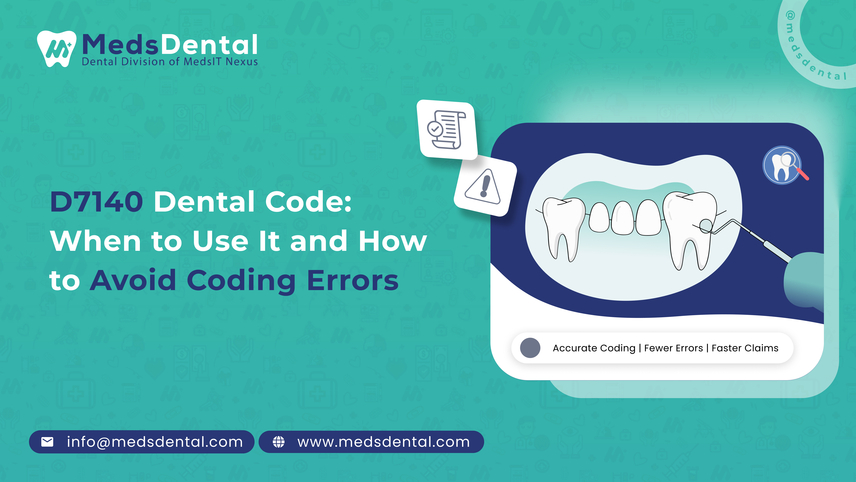
D7140 Dental Code: When to Use It and How to Avoid Coding Errors

Dental practices frequently perform routine tooth extractions, yet coding confusion still occurs when selecting the correct CDT procedure code. The D7140 dental code is widely used for simple extractions, but inaccurate reporting or insufficient documentation can create claim delays or payer denials.

Understanding the dental code D7140, when it applies, and how insurers evaluate these claims is essential for accurate billing. This guide explains the D7140 dental code description, clinical indications, documentation requirements, and common coding mistakes providers should avoid when submitting dental claims.

Key Takeaways

  • The D7140 dental code represents the extraction of an erupted tooth or exposed root through a simple method. 

  • The procedure relies on forceps or elevation rather than surgical techniques

  • Surgical extractions requiring bone removal must use a different CDT code

  • Radiographs and clear treatment notes support claims submitted with dental code D7140

  • Accurate documentation helps prevent payer disputes and improves reimbursement

What Is D7140 Dental Code?

The D7140 dental code refers to the extraction of an erupted tooth or an exposed root using simple mechanical techniques. Dentists typically perform this procedure when the tooth is visible above the gumline and can be removed without surgical intervention.

In simple terms, the D7140 dental code describes a straightforward removal of a tooth using elevators or forceps. The D7140 dental procedure code applies when the tooth can be removed intact, and no surgical bone removal or tooth sectioning is required. Minimal smoothing of the socket bone may occur, and the dentist may close the socket if necessary.

Because of these characteristics, the D7140 dental code is commonly associated with what dentists call a “simple extraction.” The procedure is less invasive than surgical extraction procedures and is typically performed during general dental visits.

When Dentists Use Dental Procedure Code D7140

Dentists report dental procedure code D7140 when a tooth can be removed without surgical access. These cases usually involve teeth that are already erupted or roots that are exposed and accessible.

Common clinical scenarios include:

  •  Severe decay where the tooth cannot be restored

  • Advanced periodontal disease causing tooth mobility

  • Fractured teeth with visible root structure

  • Orthodontic treatment requiring the removal of erupted teeth

  • Retained primary teeth interfering with permanent eruption

In these situations, the D7140 dental code applies because the tooth can be removed through a simple extraction rather than surgical techniques.

What Is Included in the D7140 Dental Procedure Code

The D7140 dental procedure code involves a routine tooth removal process performed under local anesthesia. The dentist begins by loosening the tooth using an elevator instrument before grasping it with forceps for removal. This process represents a standard simple tooth extraction within general dentistry.

During this dental extraction procedure, the tooth is elevated and removed in one piece whenever possible. Because the extraction relies on elevation and forceps removal, the procedure does not require surgical access or bone removal.

Services included within the D7140 dental code may involve basic socket management after the tooth is removed. Dentists may irrigate the socket, perform minimal smoothing of the surrounding bone, and allow natural clot formation to begin healing. If needed, the dentist may also perform a simple closure of the socket.

These steps remain within the scope of the D7140 dental procedure code because they are considered routine elements of a simple extraction.

Dental Codes D7210 & D7140: Understanding the Key Difference

Confusion between dental codes D7210 and D7140 is one of the most common dental coding mistakes. Although both codes involve tooth removal, they represent different levels of procedural complexity.

Feature

D7140 Dental Code

D7210 Surgical Extraction

Procedure type

Simple extraction

Surgical extraction

Bone removal

Not required

Required

Tooth sectioning

Not required

Often necessary

Surgical flap

Not required

Required

Complexity

Routine removal

Complex surgical removal

The D7140 dental code applies when a tooth can be removed using forceps or elevators alone. In contrast, D7210 is used when the dentist must surgically access the tooth, remove bone, or section the tooth before removal.

Accurate code selection is important because insurers evaluate extraction claims closely. When surgical steps occur during the procedure, the dentist must report the correct surgical code instead of the dental code D7140.

Documentation Needed for Dental Code D7140

Dental insurance carriers often request documentation when reviewing claims submitted with dental procedure code D7140. Proper records help confirm that the extraction met the criteria for a simple procedure rather than a surgical extraction.

Common documentation requirements include:

  • Preoperative radiograph showing the erupted tooth

  • Clinical notes describing the tooth condition

  • Diagnosis supporting the need for extraction

  • Treatment notes confirming a simple extraction method

  • Evidence that no surgical bone removal occurred

Accurate dental claim documentation helps insurers verify that the treatment qualifies for the D7140 dental code. Clear documentation also reduces the likelihood of payer requests for additional information.

D7140 Dental Code Cost and Insurance Coverage

The D7140 dental code cost can vary depending on several factors. Dental practices establish their own fee schedules based on location, operational costs, and the complexity of services provided.

Insurance coverage also influences the total cost associated with the D7140 dental code. Many dental insurance plans classify simple extractions within the basic treatment category. Under these plans, insurers often reimburse a percentage of the provider fee once deductibles and policy limits are considered.

Because coverage structures differ among insurance carriers, practices should verify benefits before treatment. Accurate billing for the dental procedure code D7140 ensures proper dental insurance reimbursement and minimizes payment delays.

Common Coding Mistakes With D7140 Dental Code

Coding mistakes involving D7140 dental code can affect both claim approval rates and practice revenue. One common issue occurs when a procedure that requires surgical access is incorrectly reported using the D7140 dental code.

Another frequent mistake involves incomplete documentation. Without radiographs or clear clinical notes, insurers may question whether the extraction met the criteria for a simple procedure.

Avoiding these dental coding errors helps practices submit cleaner claims and maintain accurate reimbursement for extraction services.

How Accurate Coding Supports Dental Revenue Cycle

Proper reporting of the D7140 dental code plays a role in maintaining an efficient dental revenue cycle. When CDT codes are used correctly and supported with proper documentation, claims move through insurance review more smoothly.

Dental teams that follow coding guidelines for dental procedure code D7140 often experience fewer claim resubmissions and faster payments. Consistent coding accuracy also improves overall financial visibility for dental practices.

How Meds Dental Supports Extraction Billing

Managing CDT coding and claim documentation can be challenging for busy dental practices. Meds Dental assists providers by reviewing claims, verifying documentation, and helping ensure that procedures such as the D7140 dental code are billed accurately.

With proper billing oversight and coding support, dental practices can reduce claim errors, improve reimbursement timelines, and maintain a more efficient revenue cycle.

FAQs

1. What is D7140 dental code?
The D7140 dental code refers to the extraction of an erupted tooth or exposed root using simple instruments such as forceps or elevators.

2. What is dental code D7140 used for?
The dental code D7140 is used when a dentist removes a visible tooth or exposed root without surgical bone removal or tooth sectioning.

3. What is the difference between dental code D7210 & D7140?
The D7140 dental code describes a simple extraction, while D7210 represents a surgical extraction that requires bone removal or tooth sectioning.

4. Is the D7140 dental code considered a simple extraction?
Yes. The D7140 dental code represents a simple extraction where an erupted tooth or exposed root is removed using elevators or forceps without surgical bone removal.

5. What is the difference between D7111 dental code and D7140 dental code?
The D7111 dental code is used to remove coronal remnants of primary teeth, while the D7140 dental code applies to the extraction of erupted teeth or exposed roots.

6. What is the surgical extraction dental code compared to D7140 dental code?
A surgical extraction typically uses codes like D7210 dental code, which involves bone removal or tooth sectioning, unlike the simple extraction described by D7140 dental code.

7. What factors influence the D7140 dental code cost?
The D7140 dental code cost varies based on geographic location, provider fees, and insurance coverage for simple tooth extraction procedures.

8. What documentation supports dental procedure code D7140?
Claims for dental procedure code D7140 typically require clinical notes and radiographs confirming that the tooth was erupted and removed through a simple extraction.

Don't wait, Get started with MedsDental today

Let's Connect